Introduction
Most teams do not miss deadlines because they cannot code.
They miss because they started building before they agreed on what “done” means.
In the agentic era, product scoping AI can translate intent into artifacts faster. It can draft a PRD in minutes, propose edge cases, and generate acceptance examples. But it cannot own tradeoffs. Humans still choose what to ship, what to delay, and what to never do.
This article is a software scoping guide for teams shipping B2B SaaS and internal tools with AI assisted scoping. It focuses on three things that hold up under pressure:
- PRDs that are shareable, not a graveyard of meeting notes
- Fit gates that stop bad bets early
- Fixed menu delivery that keeps scope stable without killing momentum
Insight: In most failed projects we have reviewed, the code was fine. The scope was not. The team shipped the wrong thing cleanly.
What changes with agentic delivery
Agentic teams move fast because they can parallelize.
- AI drafts first versions of PRD sections, user stories, and acceptance examples
- Engineers validate feasibility earlier because the artifacts are structured
- QA can start building test datasets sooner, especially for AI features
The risk is also familiar: faster output can hide unmade decisions. If you do not force decisions into the PRD, you just get better looking ambiguity.
_> Delivery and scoping proof points
Numbers we use to keep scope honest
Why scoping fails, not coding
Scope failure is usually a decision failure.
Teams avoid hard calls early, then pay for them later with rework, meetings, and “almost done” features.
Common patterns we see in software scoping:
- Undefined user and job: “Admins” is not a user. It is a bucket.
- No acceptance examples: Requirements stay abstract, so everyone imagines their own version.
- Integration sprawl: Each new tool adds auth, retries, rate limits, and support surface.
- Non functional work ignored: audit logs, permissions, performance, and data retention appear in week 6.
- Discovery artifacts not shippable: notes in docs, decisions in Slack, and context in someone’s head.
Key stat: Across 360+ projects delivered, the biggest schedule swings correlate with late scope changes, not engineering throughput. Treat this as an observation to validate in your org by tracking change requests per week and rework hours.

The agentic trap: fast drafts, slow alignment
AI assisted scoping makes it easy to produce a lot of text.
It does not make it easy to produce alignment.
If your PRD is a narrative with no gates, you get:
- stakeholders who say “looks good” and mean “I did not read it”
- engineers who start building and discover missing constraints
- QA who cannot test because “correct” is not defined
The fix is structural. Put decisions in the PRD where they cannot hide.
AI assisted scoping workflow
_> Fast drafts, explicit decisions
→ Scroll to see all steps
AI assisted scoping, same accountability
AI is useful in scoping when you treat it as a translator and a consistency checker.
It can help you:
- Turn founder intent into structured requirements
- Expand edge cases you forgot to mention
- Draft acceptance examples you can edit
- Produce a PRD that reads the same to product, engineering, and QA
It cannot:
- decide what is worth building
- own risk in regulated environments
- guarantee correctness for AI features without a test dataset and monitoring
Insight: AI assisted scoping reduces the cost of writing. It does not reduce the cost of deciding.
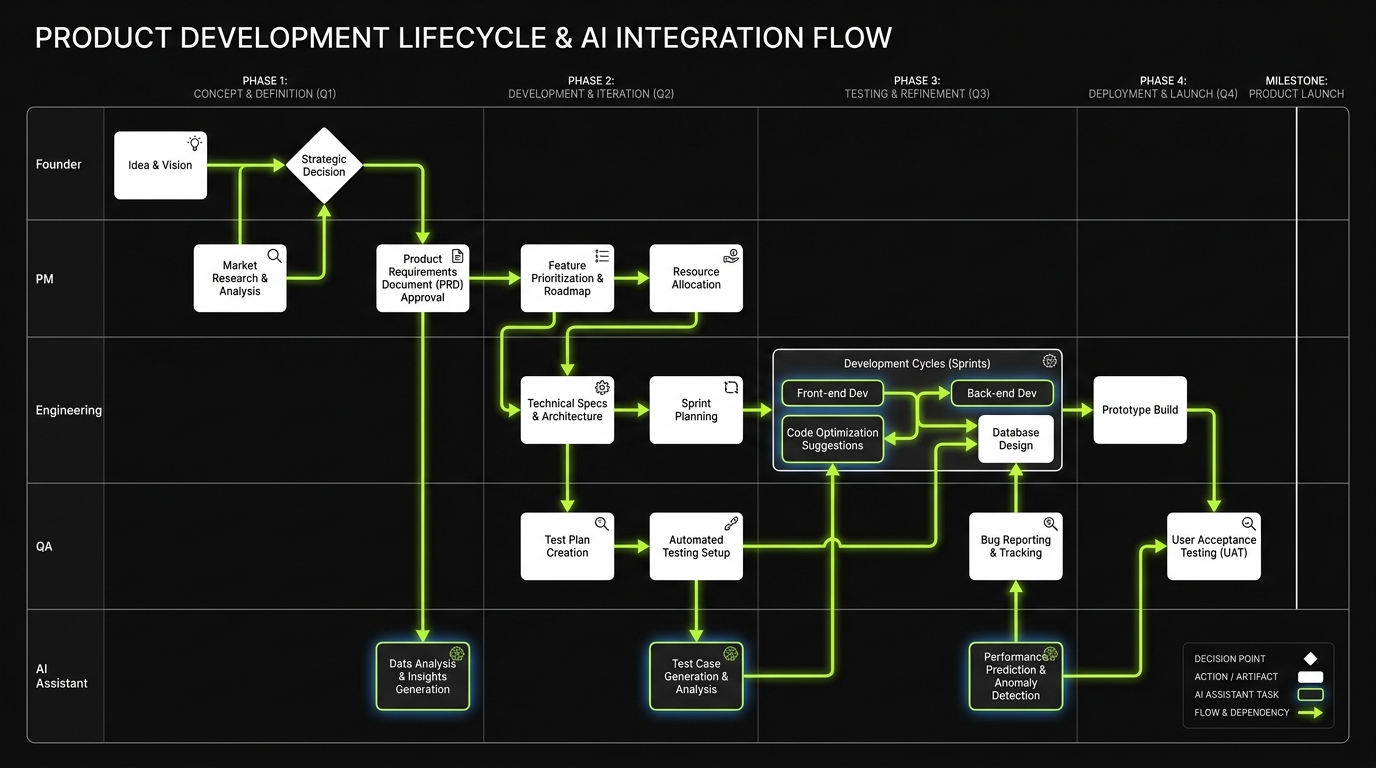
Bridging intent to acceptance examples
Founder intent usually sounds like this: “Users should be able to onboard in 2 minutes.”
Engineering needs something like this:
- Given a new user with no workspace
- When they connect Google SSO and choose a plan
- Then the system creates a workspace, assigns the Admin role, and shows the first task
A practical bridge is a two layer spec:
- Outcome: what changes for the user or business
- Acceptance examples: concrete inputs and expected outputs
For AI features, add a third layer:
- Evaluation dataset: the examples you will test against in CI and in production monitoring
This matches what we learned building and testing AI behavior: if you do not define “correct enough,” you cannot ship safely. Probabilistic outputs need datasets, judges, and drift checks, not vibes.
What a shippable PRD contains
_> Artifacts that survive handoffs
Acceptance examples
Concrete inputs and expected outputs per epic, including edge cases.
Out of scope list
Explicit exclusions with reasons and a parking lot for v1.1.
Integration budget
Named systems, data flows, and a cap that keeps MVPs small.
Non functional constraints
Permissions, audit logs, performance targets, and retention rules.
AI evaluation plan
Dataset, judges, refusal rules, and drift monitoring for AI features.
Release plan
What ships in v1, what is deferred, and what metrics define success.
PRDs that teams can ship from
A PRD is only useful if it can be handed to a self directed team and they can deliver without a week of follow up meetings.
That means two things:
- the PRD is shareable and readable in 10 minutes
- the PRD contains fit gates and acceptance examples so work does not fork
Below is a checklist you can use as an MVP PRD template for agentic delivery.
Key stat: In our delivery, teams that lock acceptance examples by the end of week 1 see fewer mid sprint reversals in weeks 2 to 3. Treat this as a hypothesis to validate by measuring reopened tickets and spec changes per week.
| PRD section | What “good” looks like | What breaks delivery |
|---|---|---|
| Problem and user | One primary user, one job, one pain | “Everyone” and “nice to have” goals |
| Success metric | 1 to 3 measurable outcomes | Vanity metrics only, no baseline |
| Scope in | Features written as user outcomes | Feature lists with no behavior |
| Acceptance examples | 5 to 15 examples per epic | “Works like X” references |
| Out of scope | Explicit list with reasons | Silent exclusions that come back later |
| Integrations | Named systems and data flows | “We will integrate later” |
| Risks and constraints | Security, compliance, latency targets | “We will figure it out” |
| Release plan | What ships in v1, v1.1 | Big bang launch only |
PRD section checklist for agentic delivery
Use this as a scoping checklist. If a line is missing, expect rework.
- One sentence product promise
- Primary user and job
- Non goals (what you are not building)
- Functional scope grouped into epics
- Acceptance examples per epic
- Data model sketch (entities, key fields, ownership)
- Integration surface budget (see next section)
- Permissions and roles
- Audit and logging needs (especially for internal tools)
- Performance targets (p95 latency, batch windows)
- AI specific (if relevant): model choice, retrieval sources, evaluation dataset, refusal rules
- Release plan with what is deferred
A good PRD reads like a contract. Not a legal one. A delivery one.
Out of scope is a first class artifact
Most teams treat out of scope as a footnote.
Make it a section with bullets, owners, and timing.
Example out of scope list:
- SSO beyond Google Workspace (reason: reduces auth complexity in v1)
- Data export to CSV (reason: support load, schedule risk)
- Multi region deployment (reason: no customer need validated)
- AI content generation (reason: correctness and compliance not ready)
Why this works:
- it stops “just one more thing” requests
- it makes tradeoffs explicit
- it creates a clean backlog for v1.1 without polluting v1
Insight: A visible out of scope list reduces conflict because it turns “no” into “not yet, and here’s why.”
Why fixed menu scoping works
Fewer reversals
When acceptance examples are locked, engineers stop rebuilding the same feature twice.
Cleaner stakeholder alignment
Tradeoffs are visible. Out of scope items do not become personal conflicts.
Faster QA start
QA can write tests early because expected behavior is concrete.
Safer AI releases
Evaluation datasets and monitoring make probabilistic behavior testable.
Fit gates and fixed menu delivery
When scope is unstable, delivery becomes negotiation.
Fixed menu delivery is a simple counter move: you offer a menu of outcomes with clear boundaries. Stakeholders can choose items, but they cannot rewrite the menu mid sprint without trading something out.
Fit gates are how you decide if an item belongs on the menu.
This matters more in the agentic era because speed increases the cost of late changes. If the team can ship faster, it can also ship the wrong thing faster.
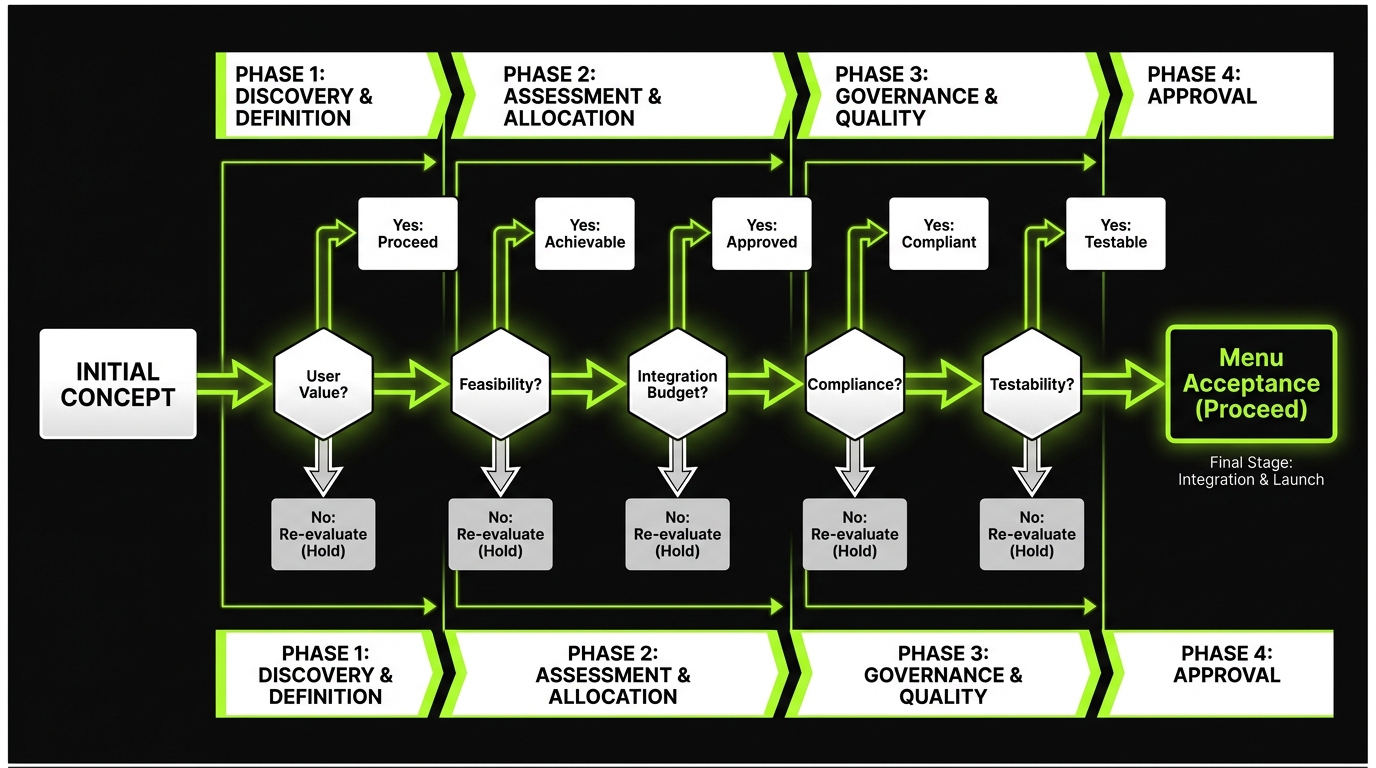
Fit gate decision tree for B2B SaaS and internal tools
Use this decision tree in scoping calls. Ask it in order.
- Is the user and job clear?
- If no, stop. Run a short discovery sprint.
- Can we define acceptance examples?
- If no, it is not ready. Draft examples first.
- Does it fit the integration surface budget?
- If no, cut integrations or split into phases.
- Does it create compliance obligations?
- If yes, add compliance by design tasks now, not later.
- Can QA verify it in CI?
- If no, define test data, mocks, and evaluation datasets.
- Does it move a measurable metric?
- If no, it is a nice to have. Park it.
For internal tools, add one more gate:
- Does it reduce cycle time for a team you can name? If you cannot name the team and the workflow, it is probably a dashboard that no one owns.
Integration surface budget: the 0 to 3 rule
Rule of thumb: 0 to 3 integrations for an MVP.
Why:
- each integration adds auth, rate limits, retries, error states, and support
- integrations multiply edge cases and increase QA surface
- in B2B, integrations also increase procurement and security review time
A simple budget table you can put in the PRD:
| Integration | Must have for v1 | Data in | Data out | Owner | Risk |
|---|---|---|---|---|---|
| Slack | No | Events | Notifications | Product | Medium |
| HubSpot | Yes | Contacts | Activity logs | Sales ops | High |
| S3 | Yes | Files | Signed URLs | Engineering | Medium |
If you need 6 integrations, you do not have an MVP. You have a platform plan.
Example: In enterprise estimation work like SmartProjects, integration complexity is often the hidden variable. A single “simple” connector can dominate the schedule if requirements are vague. That is why we budget integrations early, not after UI is approved.
Rework prevention: drift signals in week 2 to 3
Week 2 to 3 is where scope drift shows up.
Watch for these signals:
- acceptance examples keep changing after implementation starts
- engineers ask “what should happen here?” more than twice per epic
- new roles or permissions appear mid sprint
- integration requirements expand from “read only” to “sync both ways”
- QA cannot write tests because expected outputs are subjective
Mitigations that work:
- freeze acceptance examples for the sprint
- force tradeoffs: add one thing, remove one thing
- capture drift in the out of scope list, not in Slack
- schedule a 30 minute fit gate review, not a 2 hour debate
If you do this, fixed menu delivery feels fair. It is not rigid. It is explicit.
No. It speeds up drafting and consistency checks. A PM and tech lead still own decisions, tradeoffs, and risk.
Problem and user, success metric, scope in, out of scope, 0 to 3 integrations, acceptance examples, and a release plan. If any of these are missing, expect rework.
Define evaluation datasets, acceptance thresholds, and failure modes. Then test in CI and monitor drift in production. Treat the AI feature as a product inside the product.
Use fixed menu delivery. Allow changes, but require a trade: add one thing, remove one thing. Capture it in a PRD changelog so decisions do not disappear into chat.
Conclusion
Product scoping AI changes the speed of translation. It does not change the need for decisions.
If you want agentic delivery to stay production ready, treat scoping as a system:
- Write PRDs that ship, with acceptance examples and testability baked in
- Run fit gates before work starts, not after a sprint goes sideways
- Budget integrations like you budget time and money
- Capture out of scope as a first class artifact
- Watch week 2 to 3 drift signals and trade scope instead of expanding it
Insight: The best scoping calls end with fewer words and more artifacts. A shareable PRD beats perfect meeting notes every time.
Actionable next steps you can do this week:
- Take your current PRD and add an out of scope section with 10 bullets.
- Pick one epic and write 8 acceptance examples.
- Count integrations. If you have more than 3, create a phased plan.
- Add one fit gate review to your calendar before the next sprint starts.
That is how you keep speed without losing control.