• 01Services
  • 02Portfolio
  • 03About
  • 04Careers
  • 05Blog

Services

All services

New · AI-native delivery

Senior engineers with AI coding agents

Ship a production MVP in weeks, or install agents into the team you already have.

Agentic MVPNewA production MVP your customers can rely on. Validate in 1–2 weeks, launch in 4–8, own all of it.Explore
  • Agentic SDLCAI coding agents installed into your delivery process in two weeks, with guardrails and metrics.
Agentic SDLC hub
>_ProductScope StudioFrom an idea to a shareable PRD_> Open_> Open
Emailcontact@apptension.comCall+48 533 352 052

HQ in Poznań, Poland

Start a project
Services
About
Portfolio
Careers
Blog
Get in touch
All technology hubs

Stack hub/Reviewed 16 November 2026/15 min read

Three.js and WebGL Development

Interactive 3D for product sites, configurators, and data visuals, built on Three.js and React Three Fiber. We plan the WebGPU path with a WebGL 2 fallback, compress every asset, and test on real mobile hardware so scenes hold up after launch.

Short answer

Choose Three.js when 3D carries the product story and must load fast on a mid-range phone. We ship WebGL and WebGPU scenes with React Three Fiber, compressed assets, and frame budgets set before the first shader is written.

Clue 01118k+GitHub stars on mrdoob/three.js

Shake for the next clue

Source: github.com ↗
1 / 4
Three.js and WebGL in numbers
118k+ GitHub stars on mrdoob/three.js (source: github.com)
36.6M weekly npm downloads of the three package (source: api.npmjs.org)
9.2M weekly npm downloads of @react-three/fiber (source: api.npmjs.org)
4 major browsers shipping WebGPU (Chrome, Edge, Firefox, Safari) (source: web.dev)

Your route through this hub

CoversThree.jsReact Three FiberdreiWebGPUTSLGSAPglTFTypeScript

  1. Stage 1 · Understand

    Is it right for our product?

    • 01What it isThe plain-words version
    • 02Where it pays off7 proven patterns
    • 03How it fits7 steps, one request
    • 04How it got here9 milestones
  2. Stage 2 · Choose

    What would we build it with?

    • 05Toolkit17 tools mapped
    • 06Who runs it8 teams in production
    • 07Alternativesvs 3 options
  3. Stage 3 · Ship

    How do we go live without surprises?

    • 08Readiness check22 checks, scored
    • 09What breaks6 mistakes and fixes
  4. Stage 4 · Decide

    What would you do in our place?

    • 10Should you use it?Our verdict, scope and rollout
    • 11What we shipped3 case studies
    • 12Questions we get7 straight answers
    • 13Sources13 cited, 10 terms

__> Teams we have built for

Three.js and WebGL
01What it is02Where it pays off03How it fits04How it got here05Toolkit06Who runs it07Alternatives08Readiness check09What breaks10Should you use it?11What we shipped12Questions we get13Sources
01What it is

What is Three.js and WebGL?

Three.js is an open-source JavaScript library that renders 3D scenes in the browser on top of WebGL 2 and, through its WebGPURenderer, WebGPU. It provides the scene graph, cameras, lights, materials, loaders, and post-processing, so teams build interactive 3D without writing raw GPU code.

Why teams adopt it

WebGPU now ships in Chrome, Edge, Firefox, and Safari, and Three.js puts most new work into its WebGPURenderer, so a 2026 build can target modern GPUs without dropping older devices. Three.js has the largest ecosystem of any web 3D library, with React Three Fiber bringing it into React apps. GSAP became free for commercial use in 2025, which removed a licensing step from scroll-driven 3D sites.

How it works

  1. 1

    Author and export assets

    Models are built in Blender, Spline, or CAD tools and exported as glTF, the standard 3D delivery format for the web.

  2. 2

    Compress for delivery

    Tools such as glTF-Transform apply Meshopt or Draco geometry compression and KTX2 textures so files download and decode fast.

  3. 3

    Build the scene graph

    Code loads the assets into a scene with a camera and lights, either in plain Three.js or declaratively with React Three Fiber and drei.

  4. 4

    Shade with node materials

    Custom looks are written in TSL, the Three.js shading language in JavaScript, which compiles to WGSL for WebGPU or GLSL for WebGL 2.

  5. 5

    Render the loop

    setAnimationLoop drives frames on the GPU; WebGPURenderer uses WebGPU when available and falls back to WebGL 2 automatically.

02Where it pays off

Where Three.js and WebGL pays off

The jobs it does best in real products: the problem you would have, how we would build it, and who already runs it that way.

Product configurator

Problemstep 1
Buyers cannot judge colors, materials, and options from flat photos, and every variant photo shoot costs money.
Patternstep 2
One compressed glTF per product with swappable materials and parts, state stored in the URL and cart, and an AR handoff for phones.
In the wildstep 3
Shopify 3D product media via model-viewer

Data-driven hero visual

Problemstep 1
A homepage needs to show scale and activity in one glance without a wall of numbers.
Patternstep 2
Instanced points and arcs on a globe fed by a JSON snapshot, with a static placeholder first and quality tiers that drop on slow devices.
In the wildstep 3
GitHub and Stripe homepage globes

Scroll-driven launch page

Problemstep 1
A launch story has to hold attention through a long page instead of a single fold.
Patternstep 2
GSAP ScrollTrigger timelines drive the camera and shader uniforms; the render loop pauses when the canvas leaves the viewport.
In the wildstep 3
Igloo Inc landing page by Abeto

Interactive campaign moment

Problemstep 1
Event sign-ups need a reason to share beyond a confirmation email.
Patternstep 2
A small physics scene in React Three Fiber with personalized text rendered into a texture, embedded in an existing Next.js site.
In the wildstep 3
Vercel Ship 2024 badge

Digital twin and space tours

Problemstep 1
Remote buyers and operators need to inspect a real space without visiting it.
Patternstep 2
Scanned or captured spaces rendered in a viewer with custom Three.js objects for annotations, sensors, or furniture.
In the wildstep 3
Matterport Bundle SDK

Captured reality on the web

Problemstep 1
Photogrammetry meshes are heavy and still look synthetic for real places and products.
Patternstep 2
Gaussian splat captures streamed into a Three.js scene and composited with regular meshes, UI, and fog.
In the wildstep 3
Luma AI LumaSplatsThree

Browser-based WebXR

Problemstep 1
A headset app store release is slow and costly for demos, training, or pilots.
Patternstep 2
A Three.js or R3F scene with WebXR sessions, hand input, and spatial UI that also runs as a normal web page on desktop.
In the wildstep 3
Meta Immersive Web SDK
03How it fits

How a Three.js frame reaches the screen

One real request, step by step: which part of the system handles it, and why that part is there.

01 Assets02 Scene03 Materials04 Renderer05 GPU
Step 1/7·Request
Hover a part for detail
04How it got here

Is Three.js and WebGL a safe bet?

The releases and decisions that matter when you are betting a product on it, in order.

  1. 2010Mar

    Three.js repository created

    Ricardo Cabello (mrdoob) starts the project that becomes the default 3D library for the web.

    github.com
  2. 2020Sep

    Stripe ships its Three.js globe

    Stripe chose Three.js over writing its own engine for the homepage globe and held it to 60fps.

    stripe.com
  3. 2024Nov

    r171 splits WebGL and WebGPU entry points

    Three.js codesplits the WebGL and WebGPU builds and introduces three.tsl.js, so three/webgpu imports work in bundlers.

    github.com
  4. 2025Feb

    React Three Fiber v9

    R3F v9 adds React 19 compatibility, loader instances in useLoader, and a factory form of extend.

    github.com
  5. 2025Apr

    GSAP becomes free, plugins included

    With Webflow's backing, GSAP 3.13 makes the full toolset free for commercial use, including SplitText and MorphSVG.

    gsap.com
  6. 2025Nov

    WebGPU in all major browsers

    web.dev confirms WebGPU support across Chrome, Edge, Firefox 141+, and Safari 26.

    web.dev
  7. 2026Jan

    R3F v10 alpha with first-class WebGPU

    React Three Fiber v10 alpha supports WebGPURenderer and adds TSL hooks such as useUniforms and usePostProcessing.

    github.com
  8. 2026Oct

    Meta Immersive Web SDK 1.0

    Meta releases IWSDK 1.0, a Three.js-based framework for WebXR apps on Quest with physics, spatial UI, and an MCP server.

    developers.meta.com
  9. 2026Oct

    Three.js r187; R3F v10 defaults to WebGPU

    r187 adds parallel pipeline compilation in compileAsync, and R3F v10 alpha 6 makes WebGPURenderer the default canvas with a /legacy WebGL entry.

    github.com
05Toolkit

What you would build Three.js and WebGL with

The libraries and services we would actually put in your stack, and when each one earns its place. Filter by layer or language.

Language
  • Framework · JavaScript

    three.js

    The core 3D library with WebGLRenderer and WebGPURenderer; pick it for any custom 3D on the web.

    mrdoob and community118k
  • Framework · TypeScript

    React Three Fiber

    A React renderer for Three.js; pick it when 3D lives inside a React or Next.js app and shares state with the UI.

    Poimandres (pmndrs)34k
  • UI · TypeScript

    drei

    Ready-made R3F helpers for controls, text, environments, loaders, and performance; saves weeks of boilerplate.

    Poimandres (pmndrs)10k
  • UI · JavaScript

    GSAP

    Timeline and scroll animation (ScrollTrigger) for driving cameras and materials from page scroll; free for commercial use since 3.13.

    GreenSock (Webflow)31k
  • UI · JavaScript

    postprocessing

    A merged-pass effect composer for bloom, depth of field, and tone mapping on WebGLRenderer projects.

    Poimandres (pmndrs)3k
  • Framework · TypeScript

    @react-three/rapier

    Declarative Rapier physics for R3F; the stack Vercel used for its swinging Ship '24 badge.

    Poimandres (pmndrs)1.7k
  • Tooling · JavaScript

    three-mesh-bvh

    Bounding volume hierarchies for fast raycasting and collision on dense meshes; pick it when picking or hover gets slow.

    Garrett Johnson (community)3.6k
  • Tooling · TypeScript

    glTF-Transform

    CLI and SDK to compress, dedupe, resize, and convert glTF assets in CI before they reach the browser.

    Don McCurdy (community)2.1k
  • Tooling · C++

    meshoptimizer

    Mesh simplification and Meshopt compression with a small WebAssembly decoder that Three.js loads natively.

    Arseny Kapoulkine (community)8.9k
06Who runs it

Who already bets on Three.js and WebGL

Companies running it in production, and what for. Every entry links to their own write-up, so you can check our homework.

  • Builds its web runtime on Three.js, loading standard glTF 2.0 files and restoring interactive components exported from Unity and Blender.

    engine.needle.tools
  • Its landing page, built by Abeto with Three.js, three-mesh-bvh, Svelte, and GSAP, won Awwwards Site of the Year 2024.

    awwwards.com
  • Ships LumaSplatsThree, a Three.js integration that renders Gaussian splat captures inside a scene graph and works with React Three Fiber.

    github.com
  • Built the interactive Vercel Ship 2024 badge with React Three Fiber, drei, react-three-rapier joints, and MeshLine for the lanyard.

    vercel.com
  • Renders its homepage globe with Three.js, cutting dots from about 60,000 to 20,000 and disabling antialiasing to hold 60fps.

    stripe.com
  • Draws its homepage globe of live pull requests with Three.js and steps down through quality tiers when frame rate drops.

    github.blog
  • Its Bundle SDK exposes the Three.js instance used by Showcase so developers add custom objects, loaders, and effects to 3D property tours.

    developers.matterport.com
  • Built the Immersive Web SDK on Three.js with an entity component system for WebXR apps on Quest and Meta VR glasses.

    developers.meta.com
Startup · 3D tooling01 / 08

Needle

Builds its web runtime on Three.js, loading standard glTF 2.0 files and restoring interactive components exported from Unity and Blender.

Source: engine.needle.tools
07Alternatives

Three.js vs React Three Fiber vs Babylon.js vs Spline

No option wins every row. Find the row that matters most for your product and the choice usually makes itself.

Three.js vs React Three Fiber vs Babylon.js vs Spline
CriterionThree.js (vanilla)React Three FiberBabylon.jsSpline
Best forCustom scenes in any framework3D inside React and Next.js appsGame-like apps that want an all-in-one engineDesigner-built scenes with light interaction
Who builds itGraphics-literate JS engineersReact engineers with Three.js basicsEngineers comfortable with an engine APIDesigners, with developers embedding
WebGPU pathWebGPURenderer with WebGL 2 fallback and TSLDefault renderer in v10 (alpha); /legacy for WebGLWebGPU engine availablePublishes with WebGPU and WebGL rendering
EcosystemLargest: loaders, examples, add-onspmndrs: drei, rapier, xr, uikitLarge, with official tools and editorClosed tool with its own runtime
Control over performanceFullFull, plus declarative helpersFull, with engine-level featuresLimited to export settings
Native mobile outputWeb onlyWeb firstWeb first (Babylon Native is a separate project)SwiftUI and Jetpack Compose exports
Three.js (vanilla) vs
  • Best for

    Three.js (vanilla)

    Custom scenes in any framework

    React Three Fiber

    3D inside React and Next.js apps

  • Who builds it

    Three.js (vanilla)

    Graphics-literate JS engineers

    React Three Fiber

    React engineers with Three.js basics

  • WebGPU path

    Three.js (vanilla)

    WebGPURenderer with WebGL 2 fallback and TSL

    React Three Fiber

    Default renderer in v10 (alpha); /legacy for WebGL

  • Ecosystem

    Three.js (vanilla)

    Largest: loaders, examples, add-ons

    React Three Fiber

    pmndrs: drei, rapier, xr, uikit

  • Control over performance

    Three.js (vanilla)

    Full

    React Three Fiber

    Full, plus declarative helpers

  • Native mobile output

    Three.js (vanilla)

    Web only

    React Three Fiber

    Web first

08Readiness check

Is your Three.js and WebGL setup ready for real traffic?

The checks teams that run it well have in place before launch. Tick what you already have and see where you stand. Your answers stay on this device.

0%

0 / 22

Tick what you already have

  • Mobile performance budget0/5
  • Asset pipeline0/4
  • Renderer and WebGPU0/5
  • Load and render discipline0/4
  • Accessibility and SEO0/4
Mobile performance budget

01 · Mobile performance budget

Asset pipeline

02 · Asset pipeline

Renderer and WebGPU

03 · Renderer and WebGPU

Load and render discipline

04 · Load and render discipline

Accessibility and SEO

05 · Accessibility and SEO

09What breaks

Where Three.js and WebGL projects go wrong

What we find most often when we audit or inherit a codebase, and how we fix it.

  • !

    Shipping raw exports from Blender

    Fix · Compress geometry with Meshopt or Draco and textures with KTX2 in CI. Uncompressed GLBs and 4K PNG textures are the most common cause of slow 3D pages.

  • !

    Uncapped pixel ratio on high-density screens

    Fix · Clamp devicePixelRatio to 2 or lower and adapt it to measured frame time. Stripe and GitHub both turned off antialiasing to hold frame rate.

  • !

    Rendering when nothing changes

    Fix · Use on-demand rendering for static scenes and pause the loop offscreen. A busy canvas drains phone batteries and competes with scrolling.

  • !

    Porting GLSL straight to WebGPURenderer

    Fix · ShaderMaterial, RawShaderMaterial, onBeforeCompile, and EffectComposer do not work on WebGPURenderer. Rewrite them in TSL and node post-processing, or stay on WebGLRenderer for now.

  • !

    Leaking GPU memory between routes

    Fix · Dispose geometries, materials, textures, and render targets when components unmount. Watch renderer.info.memory during navigation tests.

  • !

    No fallback when the context fails

    Fix · Render a static image first and keep it if WebGL or WebGPU is unavailable. GitHub crossfades from an SVG globe to the live canvas.

Minimal WebGPU scene with a TSL material (Three.js r187)

>_ $
1
2
3
4
5
6
7
8
9
10
11
12
13
14
15
16
17
18
19
20
21
22
23
24
25
26
27
28
29
30
31
32
33
34
import * as THREE from 'three/webgpu';
import {
  color,
  mix,
  normalLocal,
  positionLocal,
  sin,
  time,
  uniform
} from 'three/tsl';

const scene = new THREE.Scene();
const camera = new THREE.PerspectiveCamera(50, innerWidth / innerHeight, 0.1,
  100);
camera.position.z = 4;

const amplitude = uniform(0.15);
const material = new THREE.MeshStandardNodeMaterial();
// Wave the surface along its normals on the GPU; compiles to WGSL or GLSL
material.positionNode = positionLocal.add(normalLocal.mul(sin(positionLocal.y
  .mul(6).add(time)).mul(amplitude)));
material.colorNode = mix(color('#1e1e2e'), color('#7c5cff'), sin(time).mul(0.5)
  .add(0.5));

scene.add(new THREE.Mesh(new THREE.IcosahedronGeometry(1, 64), material));
scene.add(new THREE.HemisphereLight(0xffffff, 0x222233, 2));

const renderer = new THREE.WebGPURenderer({
  antialias: true
}); // falls back to WebGL 2
renderer.setPixelRatio(Math.min(devicePixelRatio, 2));
renderer.setSize(innerWidth, innerHeight);
document.body.appendChild(renderer.domElement);
renderer.setAnimationLoop(() => renderer.render(scene, camera));
10Should you use it?

When Three.js and WebGL is the right call, and how we ship it

Our engineers' view after building on it: where it earns its place, where something simpler wins, and the rollout we run.

Strong fit

  • Product configurators where buyers rotate, recolor, and compare variants in the browser
  • Launch and landing pages where 3D or scroll-driven motion is the main message
  • Data visuals such as globes, networks, and digital twins fed by live data
  • React or Next.js teams that want 3D inside the existing component model

Weak fit

  • Pages where a well-shot video or static render already tells the story
  • Console-grade games that need a full engine, editor, and native builds
  • Teams with no budget for asset preparation and real-device testing

What we deliver

  • 01

    Product configurators

    glTF models with material and variant switching, state synced to cart and URL, and AR handoff where the platform supports it.

  • 02

    WebGPU with a fallback

    WebGPURenderer and TSL node materials that compile to WGSL or GLSL, so one codebase serves WebGPU and WebGL 2 devices.

  • 03

    Scroll and motion

    GSAP and ScrollTrigger timelines tied to the render loop, with reduced-motion paths and pause-when-offscreen behavior.

  • 04

    Mobile performance budgets

    Draw-call, texture-memory, and pixel-ratio budgets enforced in CI, with compressed geometry and KTX2 textures.

How we deliver Three.js work

How we would roll it out

Every phase ends at a gate. Nothing moves on until it passes, so you always know what you have and what is next.

    010203Live
  1. 01

    Phase 1

    Concept and budget

    Agree what the 3D must prove, pick target devices, and set frame, weight, and load budgets before design locks.

    You walk away with

    An agreed goal for the 3D, named target devices, and written frame, weight and load budgets.

    Gate Budgets signed off before design locks

  2. 02

    Phase 2

    Prototype on real phones

    Build one scene end to end with production assets and measure it on a mid-range Android and an iPhone.

    You walk away with

    One scene with production assets, measured on a mid-range Android phone and an iPhone.

    Gate Scene meets budgets on both test phones

  3. 03

    Phase 3

    Harden and hand over

    Add fallbacks, accessibility, and monitoring. Document the asset pipeline so your team can ship new models without us.

    You walk away with

    Fallbacks, accessibility, monitoring and a documented asset pipeline for new models.

    Live when Your team ships a new model without us

Related projects

Projects where we did this work

Explore our portfolio
Riyadh Air: 3D livery microsite built in 3 weeks
Playing

Transportation · Product Design · Product Discovery

Riyadh Air: 3D livery microsite built in 3 weeks

For the Paris Air Show we built a Three.js microsite in 3 weeks. Visitors scanned a QR code and explored Riyadh Air's new livery in English and Arabic.

View project
Expo Dubai 2020: virtual event app for 2 million users
Playing

Entertainment · Product Design · Product Discovery

Expo Dubai 2020: virtual event app for 2 million users

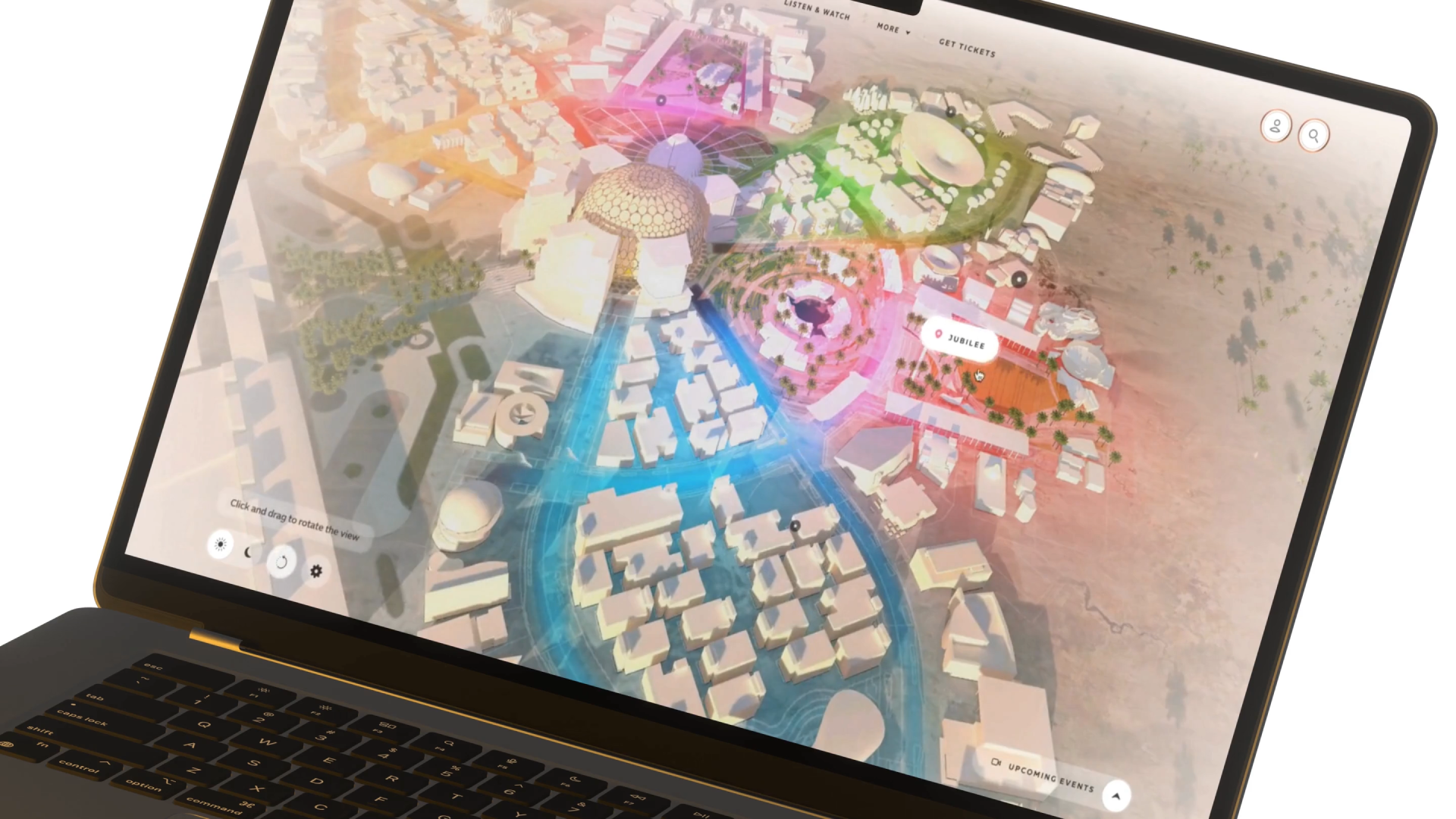
With Dogstudio we built a 3D virtual version of Expo Dubai 2020 in 9 months. 2 million people watched the opening, most of them in the mobile app.

View project
Park management system for a technology theme park
Playing

Entertainment · Product Design · Product Discovery

Park management system for a technology theme park

A visitor app, park control system and Windows sync client for a technology theme park, plus a ticketing system for a second park. Built over 8 months.

View project
12Questions we get

What teams ask us about Three.js and WebGL

Straight answers from the engineers who build with it. Missing yours?

Ask an engineer

7 questions

Start on WebGPURenderer for new work unless you depend on existing GLSL. It uses WebGPU where available and falls back to WebGL 2 automatically, and the Three.js team now puts most new features into it. Stay on WebGLRenderer if you rely on ShaderMaterial, onBeforeCompile, or EffectComposer, since those do not run on WebGPURenderer.

Safari 26 ships WebGPU on iOS and iPadOS 26, and Chrome supports it on Android 12+ devices with Qualcomm or ARM GPUs. Firefox on Android and Linux is still in progress as of late 2025. Plan a WebGL 2 fallback, which WebGPURenderer provides out of the box.

Pick React Three Fiber when the 3D lives inside a React or Next.js app and shares state with the UI, since it gives you components, hooks, and the drei helper library. Pick plain Three.js for framework-agnostic embeds or when you want no React runtime cost. Both render the same Three.js objects, so performance is set by the scene, not the wrapper.

Set budgets for draw calls, triangles, and texture memory up front, compress assets with Meshopt or Draco and KTX2, and cap the pixel ratio. Render on demand, pause offscreen, and step down quality when frame time rises. Test on a mid-range Android phone, not only on flagship devices.

Spline fits designer-owned scenes with simple hover, click, and scroll states, and it can publish to web, React, iOS, and Android. Move to custom Three.js or React Three Fiber when you need data-driven scenes, configurator logic tied to a cart, custom shaders, or tight control over load size and frame rate.

Yes. Since GSAP 3.13 in April 2025, the full toolset, including former Club plugins such as SplitText and MorphSVG, is free for commercial use thanks to Webflow. It installs from the public npm package, and ScrollTrigger is the usual way to tie camera moves to page scroll.

It can if the canvas blocks the main thread or replaces real content. Keep text and product data in HTML, show a static poster first, and load the 3D bundle and assets after the page is interactive. Done that way, the canvas is a progressive enhancement rather than the page's critical path.

13Sources

Three.js and WebGL glossary and sources

Reviewed by our engineers. Last updated 16 November 2026.

WebGL 2
The established browser graphics API based on OpenGL ES 3.0, supported on nearly every device and used as the fallback backend.
WebGPU
The modern browser API for GPU rendering and compute, shipping in Chrome, Edge, Firefox, and Safari as of late 2025.
WGSL
The WebGPU Shading Language, the shader language WebGPU executes.
TSL
Three.js Shading Language: shader logic written as JavaScript nodes that compiles to WGSL or GLSL depending on the backend.
Node material
A Three.js material whose properties such as color or position are TSL node graphs, required for custom looks on WebGPURenderer.
glTF
The Khronos standard format for delivering 3D scenes and models on the web, usually shipped as a binary .glb file.
Draw call
One command from the CPU telling the GPU to render a batch of geometry; too many per frame is a common mobile bottleneck.
KTX2
A GPU-compressed texture container, typically with Basis Universal, that stays compressed in GPU memory.
Instancing
Rendering many copies of one mesh in a single draw call with per-instance transforms or colors.
Gaussian splatting
A way to render captured real-world scenes as millions of small 3D Gaussians instead of triangle meshes.

Sources

  1. [1]three.js releases (r171 to r187)github.com ↗
  2. [2]three.js manual: WebGPURenderergithub.com ↗
  3. [3]WebGPU is now supported in major browsers (web.dev)web.dev ↗
  4. [4]React Three Fiber v10 alpha 6 release notesgithub.com ↗
  5. [5]GSAP 3.13: free for everyonegsap.com ↗
  6. [6]How we built the GitHub globegithub.blog ↗
  7. [7]Stripe: To design and develop an interactive globestripe.com ↗
  8. [8]Vercel: Building an interactive 3D event badge with React Three Fibervercel.com ↗
→Keep exploring

Built alongside it

  • Related hubReact & Next.js DevelopmentReact and Next.js product UIs that stay fast under real SaaS usage.
  • Related hubTypeScript DevelopmentStrict TypeScript codebases, typed APIs and JS-to-TS migrations with senior ownership only.
  • Related hubReact Native DevelopmentCross-platform iOS and Android with production release ownership.

Longer reads

  • How to run product design process in an AI enabled eraA practical product design process for AI enabled products: what changes, what stays, and how to ship safely with clear metrics, tests, and feedback loops.
  • How to Choose a Node.js, Python, React, or React Native PartnerScore Node.js, Python/Django, React/Next.js, and React Native partners on senior ownership, stack proof, AI delivery governance, compliance, trial sprints, and handover. Senior engineers only.

How we deliver it

  • End-to-end Software Development
  • Hybrid Teams
  • SaaS Development

Interactive 3D

Ship 3D that loads on real phones

Three.js, React Three Fiber and WebGPU with budgets set before design locks.

Apptension site footer

Taking new projects

Have a product to build, fix or scale?

Apptension is a senior-only software development company headquartered in Poznań, Poland. Since 2012 our engineers have shipped 360+ AI and SaaS products for startups, scale-ups and enterprises across the US, UK and EU: agentic MVPs, RAG and voice AI systems, multi-tenant SaaS and legacy modernization.

Projects shipped
360+
Founded
2012
Senior engineers
30+
Client CSAT
100%

Send a few lines about your product. A person from our team replies within one business day.

Start a projectScope it in Scope Studio
  • Emailcontact@apptension.com
  • Phone+48 533 352 052Poznań, Poland

  • Agentic MVP developmentNew
  • Agentic SDLC implementation
  • Product & SaaS development
  • Legacy modernization
  • Generative AI development
  • SaaS development company
  • Vibe-coded prototype to production
  • End-to-end software development
  • Senior engineering team extension
  • Product consulting & discovery
  • Tech due diligence for investors
  • All services

  • LLM application engineering
  • RAG & retrieval engineering
  • Voice AI agent development
  • MCP server development
  • LangGraph & LangChain agents
  • AI agent evaluation & observability
  • Node.js development company
  • Python & Django development
  • React & Next.js development
  • React Native app development
  • All expertise

  • Open-source SaaS Boilerplate
  • SaaS P&L model template
  • Walkthrough Studio
  • Agentic SDLC playbook
  • AI SDLC maturity assessment
  • Agentic SDLC ROI calculator
  • Founder resources
  • Events & exec dinners
  • Open source
  • Builder's Toolkit

  • Boutique vs large software house
  • Build vs buy vs partner
  • How to choose an AI & RAG partner
  • Team augmentation without chaos
  • Django vs Node.js for SaaS
  • React Native vs Flutter
  • AI in regulated industries
  • All guides

  • About Apptension
  • Case studies
  • Careers
  • Blog
  • Tech Radar
  • Agentic SDLC hub
  • Contact

Senior AI engineers shipping enterprise-grade AI and SaaS with startup speed.

Headquarters

Apptension sp. z o.o.23 Lutego 26
61-743 Poznań, Poland (opens Google Maps)

VAT-ID PL7831720203 · REGON 360404804
KRS 0000534235

Follow Apptension

Client reviews on Clutch

© 2012–2026 Apptension sp. z o.o. All rights reserved.

Privacy policySitemapllms.txt