Direct answer
Choose a stack partner when you need senior engineers who own production work on Node.js, Python/Django, React/Next.js, or React Native without junior bait-and-switch. Score every vendor on senior ownership, stack depth proof, AI delivery governance, compliance readiness, a paid trial sprint, and clean handover. Apptension ships senior-only pods across these stacks with 360+ projects since 2012.
Insight: Stack fluency is table stakes. The hire decision is whether the people in the proposal stay on the critical path and leave artifacts your team can run.
Format choice: one hub guide with four stack sections beats four thin listicles. Shared criteria keep procurement honest. Stack sections link to money pages for Node, Python, React, and React Native.
_> Proof you can cite
Public delivery metrics
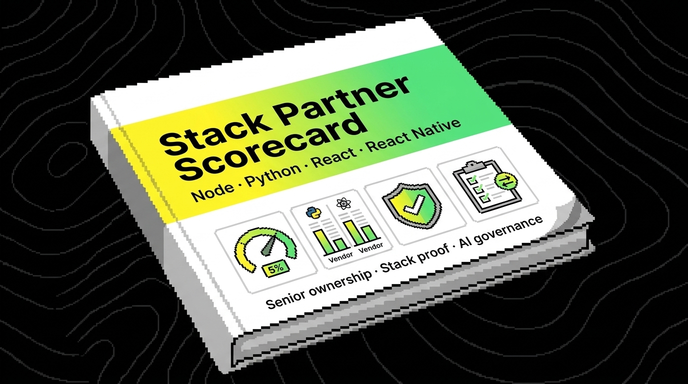
The Stack Partner Scorecard
Score each shortlisted vendor 0 to 2 on every row. 0 = claim only. 1 = partial evidence. 2 = artifact you can keep.
| Criterion | What to demand | Pass signal | Fail signal |
|---|---|---|---|
| Senior ownership | Named seniors on the critical path | Proposal names match delivery roster | Senior sales face, junior bench |
| Stack depth proof | Shipped systems in this runtime/framework | Architecture notes, repo patterns, case outcomes | “We do all stacks” with no depth |
| AI delivery governance | How AI coding tools are controlled in delivery | Review gates, secrets policy, eval for AI features | Unrestricted copilots with no audit story |
| Compliance readiness | Data classes, retention, audit trails | Security questionnaire answers with ops evidence | Policy PDF only |
| Trial sprint | Paid spike on your repo or codebase | Working PR, notes, and keepable harness | Free discovery that never touches code |
| Handover | Docs, tests, ownership after exit | ADRs, runbooks, CI that your team runs | Knowledge locked in vendor heads |
Key rule: Reject claim-only answers. A vendor that will not run a paid spike on your stack is selling a brochure.
One-week diligence path
_> From shortlist to defendable hire
→ Scroll to see all steps
Node.js partner checklist
Hire a Node.js partner when real-time I/O, TypeScript monorepos, or API-heavy SaaS dominate. Demand proof of production APIs, WebSockets or event pipelines, observability, and rate limits. Ask who owns on-call for the first production release.
Pass signals: idempotent APIs, tenancy boundaries, queue workers, and measured p95 latency. Fail signals: tutorial CRUD demos and “we will figure scaling later.”
See Apptension Node.js expertise for fit gates and process, then SaaS development or hybrid teams for engagement shape.
Python and Django partner checklist
Hire a Python/Django partner when multi-tenant SaaS, data-heavy domains, or AI services sit next to your product core. Demand multi-tenant isolation patterns, migration discipline, and admin/ops surfaces that procurement can trust.
Pass signals: tenancy model diagrams, Celery/RQ style workers, typed settings, and a path from boilerplate to production. Fail signals: Django treated as a CMS-only shop with no SaaS posture.
See Python and Django expertise and accelerate with the open-source SaaS Boilerplate.
React and Next.js partner checklist
Hire a React/Next.js partner when the product UI is a revenue surface, not a marketing site. Demand TypeScript discipline, performance budgets, design-system reuse, and auth/tenancy-aware frontends.
Pass signals: Core Web Vitals ownership, accessible components, and clear server/client boundaries. Fail signals: pixel-only freelancers with no production ops story.
See React and Next.js expertise.
React Native partner checklist
Hire a React Native partner when you need one senior mobile team for iOS and Android with production quality bars. Demand release trains, crash-free metrics, offline/edge cases, and store compliance awareness.
Pass signals: named release owners, device matrix, and shared design language with web when relevant. Fail signals: “we will wrap a webview” as the default architecture.
Artifacts to keep after the spike
_> Transfer capability, not dependency
Architecture decision records
Why this stack and these boundaries were chosen.
CI quality gates
Lint, typecheck, tests, and security scans your team can run.
Observability baseline
Logging, tracing, and error budgets for the first production path.
Staffing letter
Named seniors, replacement policy, and decision rights.
Security answers
Data classes, secrets, and retention with ops evidence.
Handover pack
Runbooks, environments, and ownership map after exit.
How Apptension fits the scorecard
Use the same table on Apptension. Ask for artifacts, not slogans.
- Senior ownership: senior engineers only on client critical paths
- Stack depth: dedicated expertise pages for Node, Python/Django, React/Next.js, and React Native
- AI governance: production AI proof and delivery controls when the product includes AI
- Trial path: paid spikes and scoped starts before long commitments
Compare engagement models with senior-only boutique vs large software house. For AI-heavy scopes, pair with the Production Evidence Test.
Score senior ownership, production API proof, observability, compliance readiness, a paid spike, and handover artifacts. Reject junior bait-and-switch.
Demand multi-tenant isolation evidence, migration discipline, and production ops surfaces. Prefer teams that ship SaaS patterns, not CMS-only Django.
Ask who owns Core Web Vitals, TypeScript standards, auth/tenancy in the UI, and design-system reuse. Require seniors on the critical path.
Require release ownership, crash-free targets, device matrix, and store compliance awareness. Avoid webview-first defaults without product reasons.
Yes. A one to two week spike on your repo is the fastest way to validate seniority, stack depth, and handover quality before a larger commitment.
Senior engineers only. Stack hubs: Node.js, Python/Django, React/Next.js, and React Native, with Hybrid Teams or end-to-end delivery as the engagement shape.
Conclusion
Stack partner selection is an evidence problem. Use one scorecard, demand artifacts, and run a paid spike.
Next step: bring this scorecard to a conversation with Apptension. Talk to a senior engineer about your stack and go-live gate.