Introduction
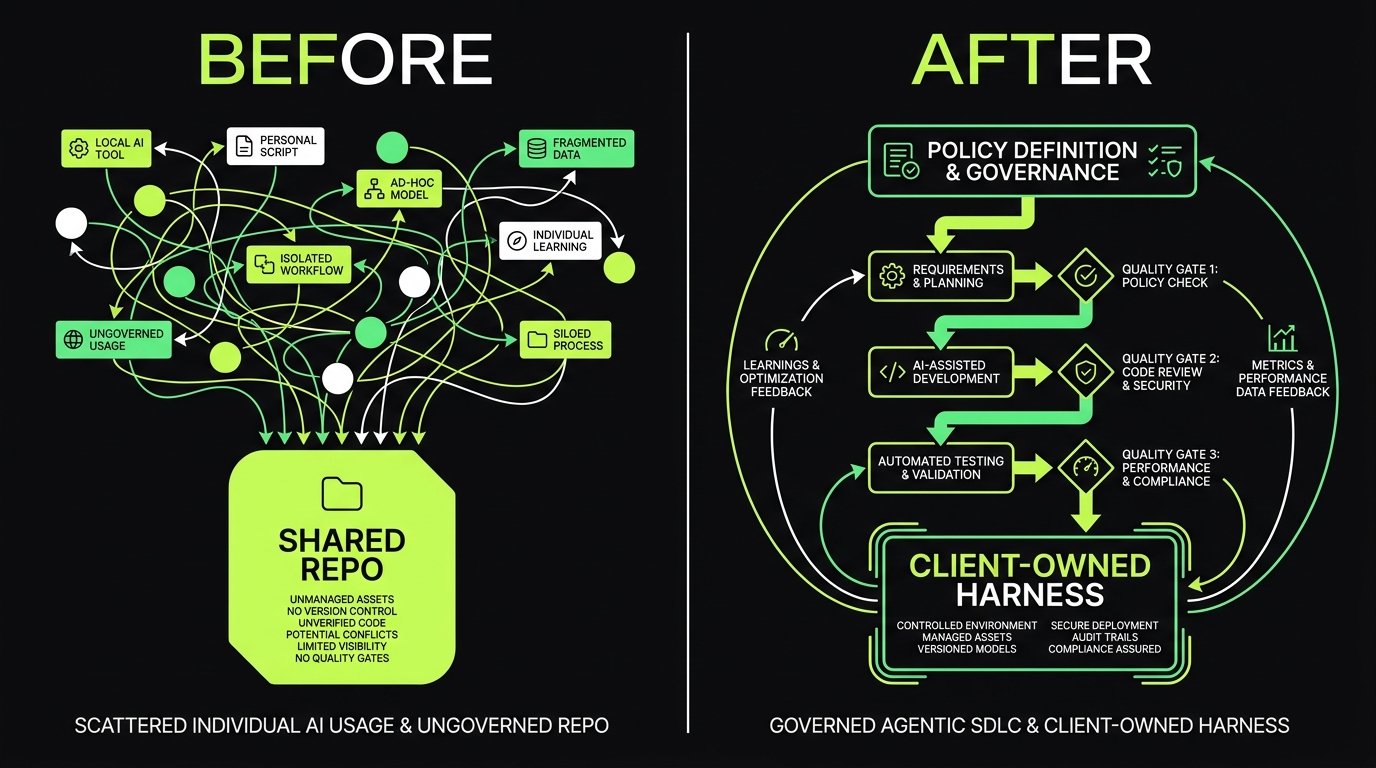
Most engineering orgs are already using AI coding tools. The problem is the usage is scattered.
One developer ships faster. Another creates cleanup work. Security asks for provenance. Management sees activity, not outcomes. That is how you end up with more commits and the same delivery pain.
This playbook is about agentic enablement that holds up in a shared repository. It is not about picking a single tool. It is about moving from individual acceleration to a governed agentic SDLC with controls you can defend in audits.
What you should expect if this is done well:
- Faster cycle time on a defined slice of work
- Stable quality signals in CI and code review
- Clear ownership for prompts, policies, and exceptions
- A repeatable engineering AI adoption program that self directed teams can run
Insight: The moment AI touches a shared codebase, it becomes a systems problem. Tooling is the easy part. Governance is the hard part.
What this guide covers
You will get:
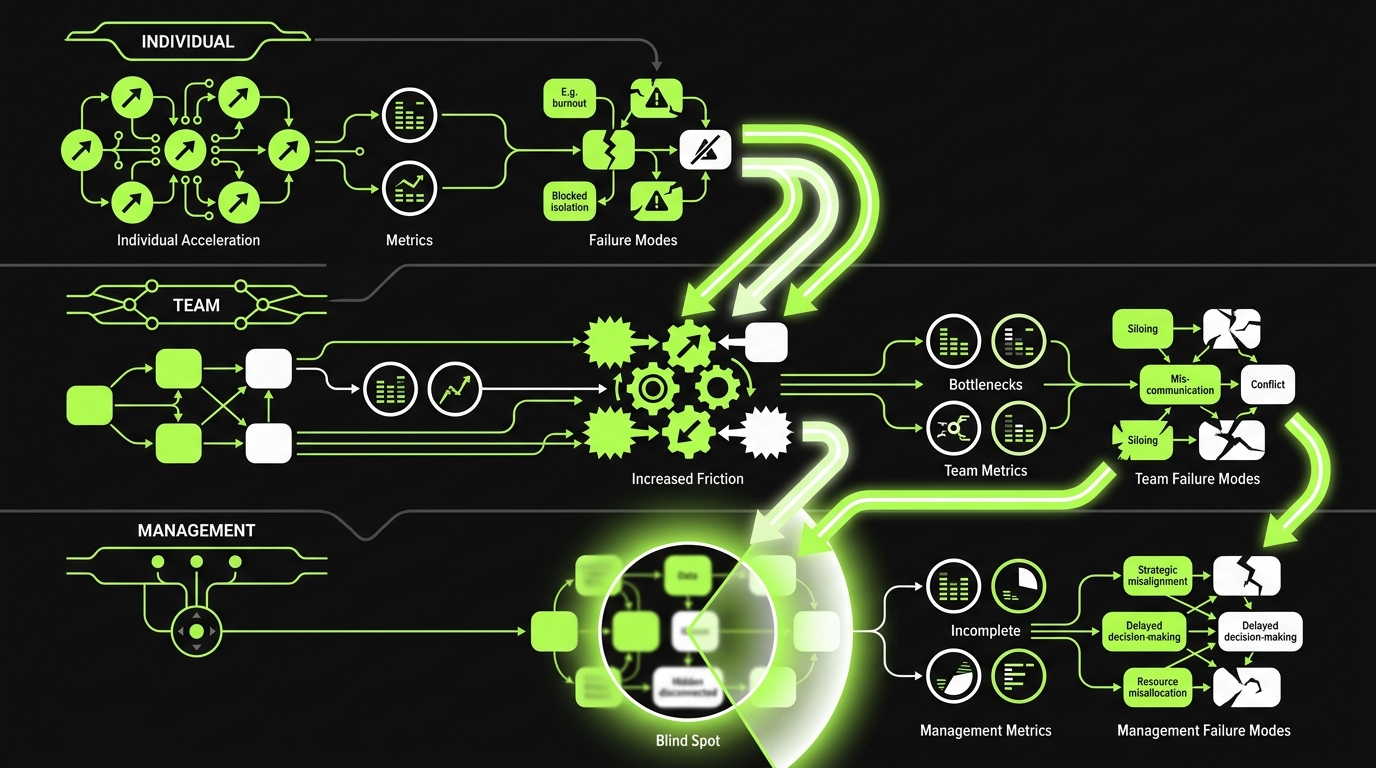
- The three layer gap that explains why early wins stall
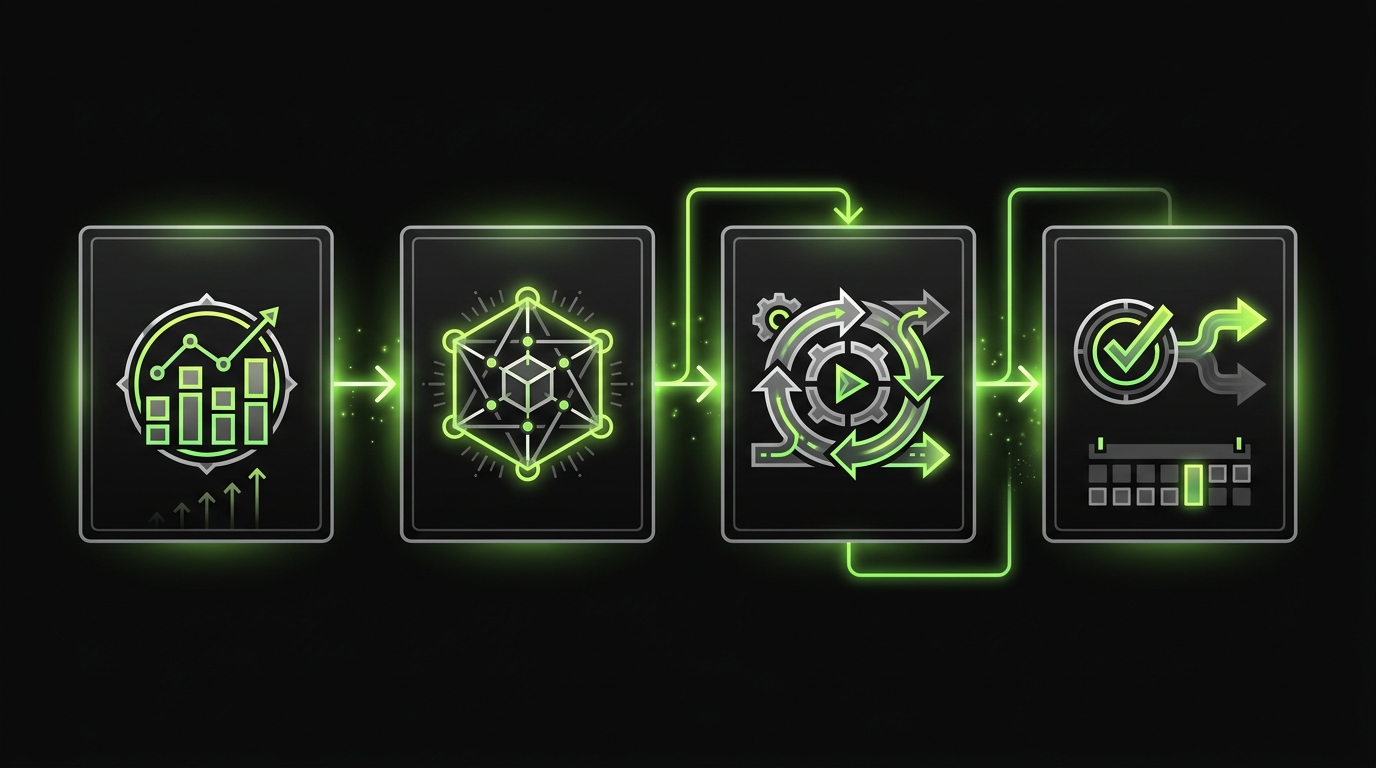
- A four phase path: assessment, workshops, embedded pilot, managed adoption
- A client owned harness: standards, skills, guardrails, quality gates, metrics
- A clear line between controlled delegation and unbounded agent freedom
- Fit criteria, including when enablement is not the right call
- Templates: maturity scorecard, pilot selection checklist, Harness Pack v1, and a week 14 scale adjust stop framework
_> Proof points we use in delivery
Concrete numbers, not vibes
The outcomes to aim for
_> If you cannot measure it, treat it as a hypothesis
Faster delivery on repeatable work
Shorter PR cycle time on a chosen workflow, without inflating review time.
Lower variance across engineers
Shared prompt patterns and repo context reduce “it works for me” behavior.
Audit friendly controls
Policies enforced in CI, with traceable exceptions and owners.
Better engineering economics
Speed gains are not canceled by rework, incidents, or dependency risk.
The three layer gap
If you only optimize for individual speed, you create team drag. If you only optimize for compliance, you kill adoption. The gap shows up in three layers.
- Individual acceleration: a few engineers get 20 to 50 percent faster on tasks like scaffolding, tests, and refactors.
- Team friction: diffs get larger, style drifts, review load spikes, and CI failures become harder to debug.
- Management blind spot: leaders see output metrics (PR count, story points) but miss input costs (review time, incidents, rework).
Key stat (internal benchmark to validate): In teams we observe moving from early adopters to early majority, the first signal of trouble is not build breaks. It is review time and rework. Measure those before you scale.
Where this tends to break:
- Prompting is private. Nobody can reproduce results.
- Agent changes bypass architecture decisions.
- Security review happens after code merges.
- Quality gates do not reflect AI failure modes (hallucinated APIs, license risk, subtle auth bugs).
Maturity scorecard
Use a scorecard to replace opinions with signals. Keep it short. Four dimensions are enough.
| Dimension | What good looks like | What to measure weekly | Common failure mode |
|---|---|---|---|
| Flow | Work moves from ticket to deploy with fewer stalls | Lead time, PR cycle time, WIP age | More PRs, same lead time |
| Quality | Changes are correct, testable, maintainable | CI pass rate, escaped defects, rework rate | Plausible code, fragile behavior |
| Control | Policies are explicit and enforced | Policy exceptions count, secret scans, dependency alerts | “We will fix it later” |
| Economics | Gains exceed added review and tooling cost | Review minutes per PR, incident cost, tool spend | Speed gains eaten by cleanup |
Scoring method:
- Rate each dimension 1 to 5.
- Write one sentence of evidence per score.
- Pick the lowest dimension as the pilot constraint.
Example constraints:
- If control is lowest, start with policy and CI gates before agent autonomy.
- If quality is lowest, start with test generation and evaluation harnesses.
- If flow is lowest, start with workflow selection and review ergonomics.
Four phase adoption path
_> A repeatable engineering AI adoption program
→ Scroll to see all steps
Four phase path to a governed agentic SDLC
A workable engineering AI adoption program needs a path that produces proof, not slide decks.
The sequence below is designed for fast onboarding and minimal disruption.
- Assessment (1 to 2 weeks)
- Workshops (1 week)
- Embedded pilot (8 to 10 weeks)
- Managed adoption (ongoing)
Insight: If you cannot measure the pilot, you cannot govern the rollout. Start with instrumentation, not enthusiasm.
Phase 1: Assessment
Goal: establish a baseline and identify where agentic enablement will help without raising risk.
Inputs to collect:
- Repo map: services, languages, CI pipelines, release process
- Security posture: secret scanning, dependency policies, audit needs
- Current SDLC metrics: lead time, PR cycle time, defect rate
- Tooling reality: what assistants and agents are already used
Deliverables:
- Baseline scorecard (flow, quality, control, economics)
- Candidate workflows for a pilot
- Draft governance boundary: what can be delegated, what cannot
Pragmatic rule:
- If you cannot get baseline metrics in week 1, treat that as a control gap and fix it first.
Phase 2: Workshops
Goal: align on standards and make them executable.
Workshop topics that actually change behavior:
- AI coding governance: what is allowed, what is banned, who approves exceptions
- Prompt and context hygiene: repo docs, ADRs, examples, golden paths
- Review protocol: what reviewers check when an agent wrote the code
- Threat modeling for agentic workflows: secrets, data exfiltration, supply chain
Outputs:
- A first version of the client owned harness (see next section)
- A shortlist of pilot workflows with clear entry and exit criteria
In our delivery teams, workshops work best when they end with a PR. Even a small one. Policy that cannot be implemented is just text.
Phase 3: Embedded pilot
Goal: embed an engineer who ships with the team and proves the harness in production.
What “embedded” means in practice:
- Same backlog, same PR process, same on call rules
- Pairing with early adopters and skeptics
- Weekly metrics review with engineering leadership
Pilot cadence:
- Week 1 to 2: set up harness gates and instrumentation
- Week 3 to 6: run the selected workflow repeatedly
- Week 7 to 10: expand scope slightly, then stabilize
Pilot outputs:
- Working agentic SDLC workflow in one repo
- A measured delta: speed, quality, and control signals
- Updated standards based on what broke
Example: In fast turnaround retail builds like the Miraflora Wagyu Shopify delivery (4 weeks), the biggest risk is not writing code. It is coordination across time zones and review latency. Agentic workflows help when they reduce back and forth, but only if review gates stay simple and predictable.
Phase 4: Managed adoption
Goal: move from a single pilot to repeatable adoption without central bottlenecks.
Managed adoption is not a committee. It is:
- A maintained harness repository
- A small set of approved workflows
- A monthly review of metrics and exceptions
- A training loop for new joiners
Common mistake:
- Rolling out “agent access” org wide without a harness. That creates unbounded freedom and a slow rollback later.
Governed agentic SDLC
Compliance by design
Policies and quality gates live in CI, not in docs. Exceptions expire and are reviewed.
Client owned harness
Self directed teams
Standards, skills, guardrails, and metrics are owned internally so the program survives staffing changes.
Measured adoption
Economics you can defend
Track review time, rework, and escaped defects so speed gains are not paid back later.
Harness Pack v1 components
_> Minimum viable governance for agentic enablement
Standards repo
ADRs, golden paths, coding conventions, and examples that agents and humans can follow.
Prompt patterns library
Task templates with context checklists so outputs are reproducible.
Quality gates in CI
Tests, linting, secret scanning, and dependency policies enforced on every PR.
Review protocol
Clear reviewer expectations for agent authored changes, including risk checks.
Metrics dashboard
Weekly visibility into PR cycle time, review time, rework, exceptions, and defects.
Exception workflow
A lightweight process with owners and expiry dates so governance stays real.
Client owned harness: the minimum viable governance
A harness is the difference between “we use AI” and “we run a governed agentic SDLC.”
It must be client owned. External teams can help build it, but you need internal ownership for standards, exceptions, and evolution.
Harness components:
- Standards: coding conventions, architectural boundaries, ADRs
- Skills: onboarding, prompt patterns, review training
- Guardrails: policies, tool configuration, approved models, data rules
- Quality gates: CI checks, test requirements, evaluation suites
- Metrics: flow, quality, control, economics
Insight: Governance that lives in a PDF dies. Governance that lives in CI survives.
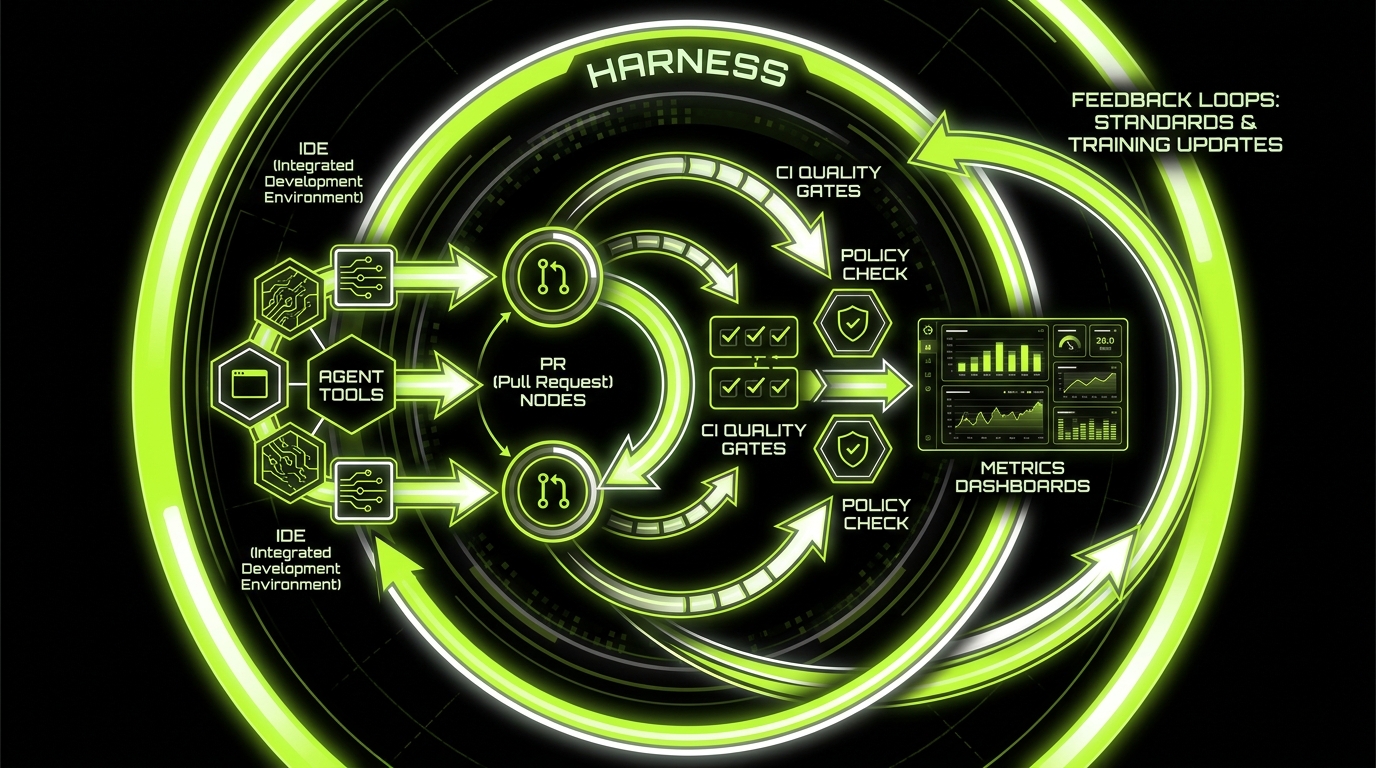
Harness Pack v1 artifact list
Keep v1 tight. You can expand later.
- Policy and standards
- AI usage policy (allowed tasks, forbidden tasks, data rules)
- Secure coding checklist for agent generated code
- Definition of Done updates (tests, docs, provenance notes)
- Repo level assets
- CONTRIBUTING guide with AI specific review rules
- Prompt patterns library (task templates, context checklist)
- Architecture decision records index
- CI and gates
- Secret scanning and dependency scanning enforced
- Lint and formatting enforced
- Test thresholds for changed modules
- Optional: license allow list for new dependencies
- Metrics and reporting
- PR cycle time dashboard
- Review time per PR
- Rework rate (follow up PRs within 7 days)
- Escaped defects and incident tags
- Exception handling
- Lightweight exception template (why, risk, owner, expiry)
- Weekly exception review
A simple exception template you can copy:
Exception request
- Scope: (repo, service, modules)
- What rule is bypassed:
- Why it is needed:
- Risk assessment: (security, quality, compliance)
- Owner:
- Expiry date:
- Rollback plan:
If you cannot expire exceptions, you do not have governance. You have debt.
Controlled delegation vs unbounded agent freedom
Agentic enablement fails when teams confuse autonomy with delegation.
Controlled delegation means:
- The agent can propose changes, not merge them
- The agent works inside a bounded context window and approved data sources
- The agent must pass the same gates as humans
- The agent must produce artifacts reviewers can inspect (tests, notes, references)
Unbounded freedom looks like:
- The agent opens broad refactors across services
- The agent adds dependencies without review
- The agent touches auth, billing, or data access code without a threat model
- The agent runs with production credentials or unredacted logs
A practical delegation matrix:
| Work type | Delegate to agent? | Conditions | Why |
|---|---|---|---|
| Test scaffolding | Yes | Must run in CI, must cover changed code | High value, low blast radius |
| Refactor within a module | Yes | No behavior change, golden tests | Improves maintainability |
| New endpoint in existing service | Maybe | ADR reference, contract tests | Risk depends on domain |
| Auth and permissions | Rarely | Mandatory human design review | Subtle failures are expensive |
| Dependency upgrades | Maybe | Lockfile diff review, security scan | Supply chain risk |
| Data migrations | No for v1 | Human review and staged rollout | High blast radius |
Key stat to track: The best proxy for “too much freedom” is not lines changed. It is the ratio of follow up fixes to initial PRs.
No. Tools change individual speed. Agentic enablement changes the SDLC so the team can absorb that speed without losing quality or control.
Not for v1. You need clear ownership for the harness, plus a small review loop for exceptions and metrics. Keep it operational.
Review time per PR and rework rate. They usually move before escaped defects show up.
Not in v1 for most teams. Start with controlled delegation where agents propose and humans approve, with CI gates enforced.
Treat that as your starting point. Document current usage, pick one workflow to formalize, and build the harness around what is already happening.
Shared harness standards: rules, tools, gates
Teams do not fail agentic adoption because they picked the wrong chat window. They fail because every engineer invents a private workflow. A client-owned harness needs three shared layers:
- Shared rules: a repo-owned instruction set (the pattern many teams call an agents file) that states coding standards, review expectations, forbidden actions, and how to ask for human help. One source of truth beats ten personal prompt libraries.
- Tool permissions: which MCP servers or integrations agents may call, with least privilege and an explicit deny list for production secrets, irreversible deletes, and customer data exports without approval.
- Quality gates in CI: tests, secret scanning, dependency policy, and a review protocol for agent-authored diffs. Autonomy expands only after the gates stay green.
Insight: Name the tools your team already uses as context. The product we sell is the harness: standards, permissions, and evidence, owned by your org.
This is the spine of Agentic Enablement Transformation after Diagnostic freezes the baseline. For how to measure whether the harness is working, see the AI coding ROI guide.
Pilot design that produces proof
A pilot should be boring. Repeatable. Easy to measure.
The goal is to prove that AI coding governance can coexist with speed.
Pilot workflow selection criteria:
- High frequency tasks with clear acceptance criteria
- Low blast radius and easy rollback
- Strong testability and deterministic behavior
- Clear ownership and reviewers available
- Minimal cross team dependencies
Avoid pilots that are “impressive” but unmeasurable:
- Greenfield prototypes with no users
- Massive refactors with unclear end state
- Work that depends on external vendors and long feedback loops
Example: On large scale platforms like the ExpoDubai virtual event build (2 million visitors over 9 months), the riskiest parts are integration points and release stability. A good pilot there is not “rewrite a core service with an agent.” It is “agent assisted contract test generation for one integration,” measured across releases.
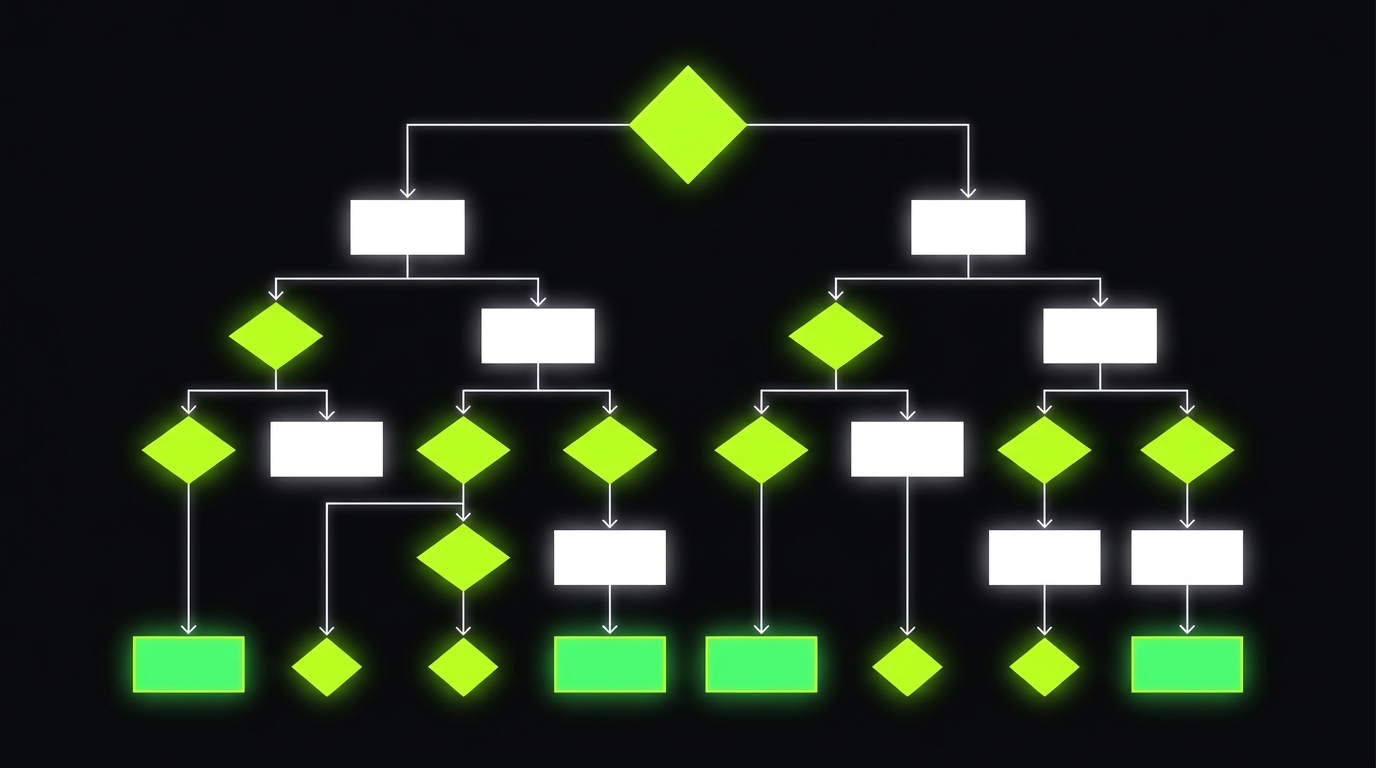
Week 14 scale adjust stop framework
By week 14, you should have enough evidence to decide. Not perfect evidence. Enough.
Use this three way decision.
Scale when:
- Flow improves by a meaningful margin (define it, for example 15 percent PR cycle time reduction)
- Quality does not regress (CI pass rate stable, escaped defects not up)
- Control signals improve (fewer exceptions, fewer policy violations)
- Economics make sense (review time does not explode)
Adjust when:
- Flow improves but quality drops
- Quality improves but flow does not
- Exceptions pile up without expiry
Stop when:
- Escaped defects rise and you cannot attribute and mitigate
- Security cannot sign off on data handling
- Review time per PR increases enough to cancel speed gains
A simple weekly scorecard table for the pilot:
| Metric | Baseline | Week 6 | Week 10 | Week 14 | Decision note |
|---|---|---|---|---|---|
| PR cycle time (hours) | |||||
| Review time (minutes) | |||||
| CI pass rate (%) | |||||
| Rework rate (%) | |||||
| Policy exceptions (count) |
If you cannot fill this table, you are not running an agentic SDLC pilot. You are running a demo.
Conclusion
Agentic enablement is not a tool rollout. It is an SDLC change.
If you only give people agents, you will get scattered wins and shared pain. If you build a client owned harness and run a measured pilot, you can ship faster without losing control.
What to do next:
- Map your current state using the maturity scorecard (flow, quality, control, economics)
- Pick one pilot workflow using the selection criteria, not gut feel
- Build Harness Pack v1 and enforce it in CI
- Run the four phase path and make a week 14 decision: scale, adjust, or stop
When enablement is a fit:
- You have a real product, real users, and a real SDLC
- You can instrument delivery and quality
- You have leaders willing to enforce guardrails
When to say no:
- You cannot define ownership for policies and exceptions
- You need AI to compensate for missing engineering fundamentals
- You are not willing to measure outcomes beyond “we shipped more”
Final thought: The best agentic SDLC is boring in production. It is predictable, measurable, and easy to audit. That is the point.
Fit check
Quick self check:
- Do we know our baseline PR cycle time and escaped defect rate?
- Can we enforce secret scanning and dependency policies today?
- Do we have a place to store standards, prompts, and ADRs?
- Who owns exceptions and who approves them?
If you answered “no” to two or more, start with the harness and metrics before you expand agent autonomy.