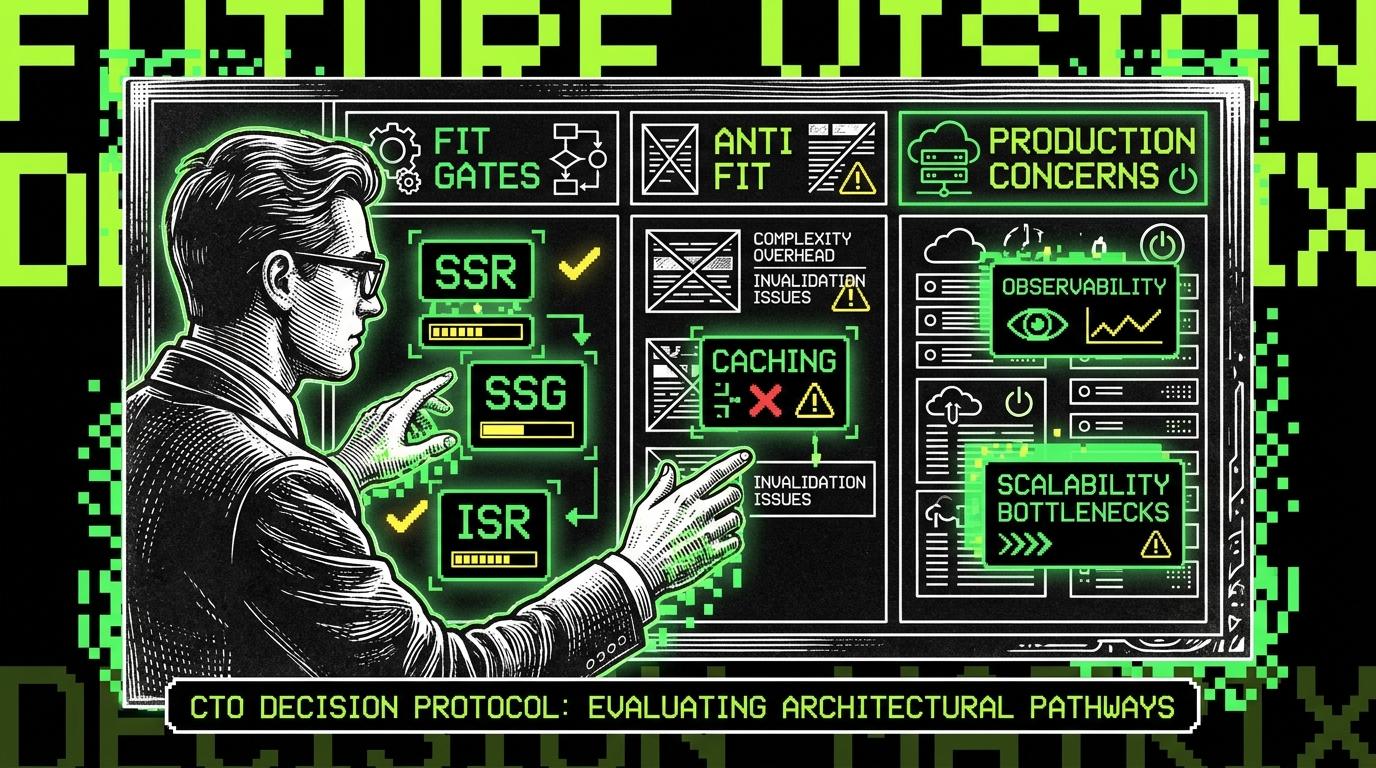
Founders often ask the same question in different words: “Should I hire a team now, or should I build a prototype first?” The honest answer is that hiring early can work, but it usually fails in a predictable way. You spend most of your capital converting uncertainty into software, not into evidence.
A bounded prototype is a way to buy clarity on the riskiest parts of the product without committing to the cost structure of a full team. “Bounded” means it has clear edges: a limited scope, a time box, and explicit non-goals. It is not a smaller version of the full product. It is a tool to test whether the product has a shape worth scaling.
This is not an argument against engineering teams. It is an argument for sequencing. Validate first, then hire with intent once the product shape is proven and you can specify what “good” looks like in production.
The expensive failure mode: hiring before you have signal
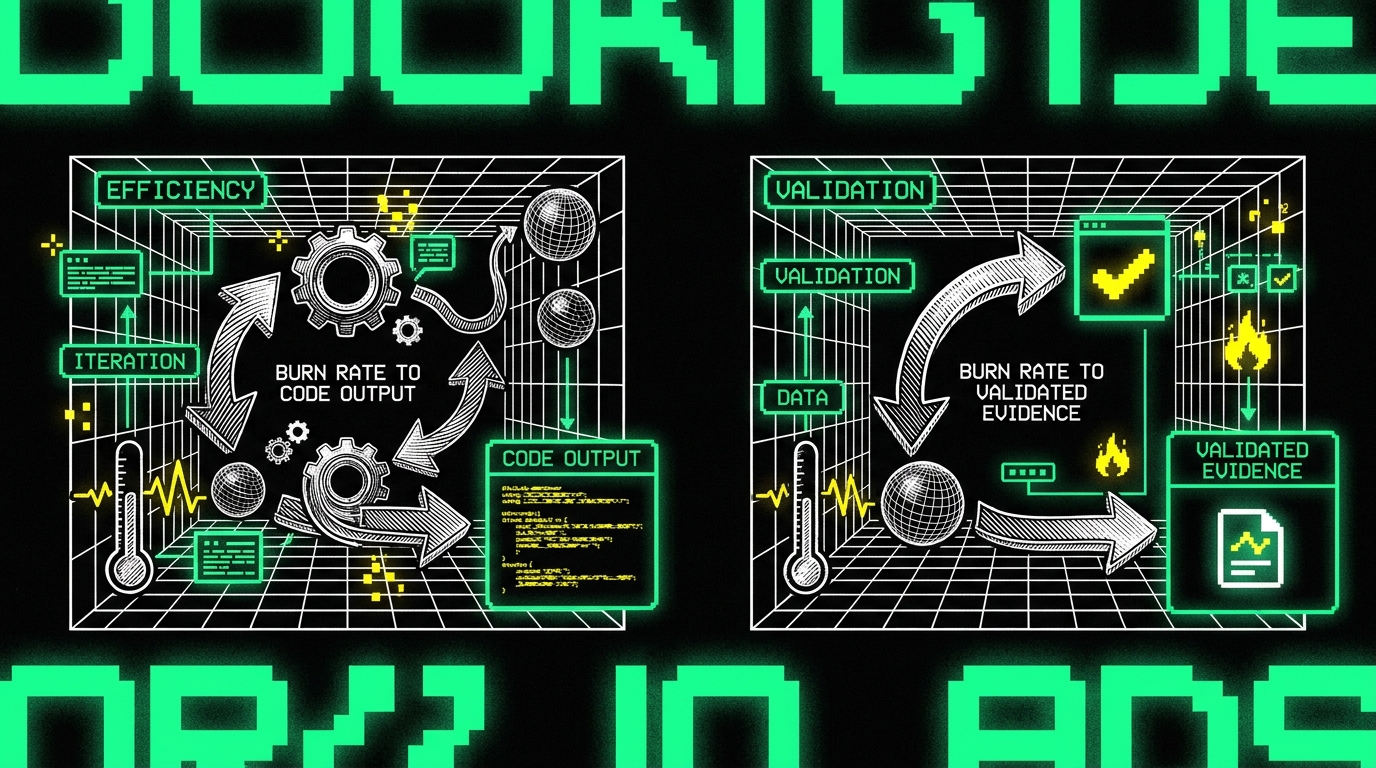
When you hire a full engineering team too early, you create a machine that needs work every week. That machine will ship. The problem is that shipping is not the same as learning. If the product direction is still undefined, a team can produce a lot of output while the business remains stuck on the core question: “Will anyone consistently use this?”
In practice, early hiring fails in three common ways. First, scope expands because every stakeholder can imagine “just one more feature,” and there is no evidence-based boundary to push back with. Second, quality becomes an argument instead of a decision, because “production-ready” means different things to different people. Third, burn rate becomes the roadmap driver, because the company must justify the team’s existence with visible work.
Founders often notice this only after 6 - 12 weeks, when they have a backlog full of tickets but no clean read on demand. At that point, the sunk cost makes it harder to stop. The team is now a fixed expense, and “pause and rethink” feels like failure even when it is the rational move.
If you cannot define what success looks like in metrics (activation, retention, paid conversion), you will measure progress in commits, tickets, and meetings.
What a bounded prototype is (and what it is not)
A bounded prototype is an intentionally constrained build that targets the highest-risk assumptions. It can be a clickable UX prototype, a concierge workflow with a thin layer of software, or a narrow vertical slice that includes one real user journey end to end. The key is that it is designed to answer specific questions, not to impress with completeness.
Bounded does not mean sloppy. It means explicit tradeoffs. For example, you might accept manual onboarding, a simplified permissions model, or a single payment plan if those choices let you test whether users complete the core job. You can still keep engineering hygiene where it matters: clear interfaces, basic logging, and a deployment you can reproduce.
It is also not a “mini MVP” that tries to satisfy every stakeholder. A bounded prototype has non-goals written down. Examples of non-goals that keep teams sane include: “No admin panel,” “No multi-tenant architecture,” “No localization,” or “No complex role-based access control.” These are often important later, but deadly to validate early.
Boundaries you should write down before work starts
Most prototypes fail because boundaries live in someone’s head. Write them down and treat them as constraints, not suggestions. A good boundary list makes it easier to say “not yet” without drama.
- Time box: 2, 4, or 8 weeks, with a fixed demo date and a decision meeting on the calendar.
- User journeys: 1 - 3 critical flows, such as “sign up → connect data source → see first result.”
- Data scope: sample data, synthetic data, or one real integration (not five).
- Quality bar: what must be stable (for example, payments), and what can be rough (for example, internal tooling).
- Non-goals: features and architectural work that are explicitly deferred.
At Apptension, when we run PoC or MVP engagements, we treat boundaries as a delivery artifact. It reduces negotiation overhead during the build and makes the validation outcome easier to interpret because you know what you did not test.
What “real early signal” looks like (and what is noise)
Founders often confuse enthusiasm with signal. A user saying “this is cool” is not evidence. A pilot customer agreeing to a meeting is not evidence. Even a waitlist can be misleading if it is driven by curiosity rather than intent. Early signal is behavior that costs the user something: time, effort, money, or reputation.
To make signal measurable, define a small set of metrics tied to the core job. For a B2B workflow product, that might be “time to first value” and “weekly active teams.” For a consumer product, it might be “activation rate” and “day 7 retention.” The point is not perfection. The point is that you can run the same measurement next week and compare.
A strong early signal is repeatable behavior from a defined cohort, not one excited conversation.

Concrete metrics to use during validation
Pick metrics that you can observe without interpretation. Avoid vanity metrics like total signups if you do not track what users do after signing up. A small set of clear numbers beats a dashboard full of guesses.
- Activation Rate: percent of new users who complete the first meaningful action (for example, “created first project” or “connected first bank account”).
- Time to First Value (TTFV): median time from signup to the first useful outcome (for example, “first report generated”).
- Retention: day 7 or week 4 retention for consumer; weekly active users or active accounts for B2B.
- Feature Adoption Rate: percent of active users who use the key feature at least once in a period (for example, “exported a report this week”).
- Conversion: percent who start a trial and then pay, or percent who move from pilot to contract.
Also track at least one friction metric. Two practical ones are Customer Effort Score (CES), collected right after a workflow (“How easy was it to complete?” on a 1 - 7 scale), and Support Load, measured as support tickets per 100 active users. If your prototype “works” but creates a support fire, scaling will hurt.
Evidence that your pricing and positioning are not fantasy
Validation is not only product. It is also willingness to pay and clarity of positioning. A bounded prototype can test this without building a full billing system by using paid pilots, deposits, or usage-based invoices handled manually.
Examples that count as real evidence include: a pilot fee paid before custom work begins, a signed order form with a start date, or a procurement process initiated by the customer (even if it is slow). Examples that are weaker include: “we have budget next quarter,” “send us a proposal,” or an LOI with no commercial terms. Treat those as leads, not proof.
Mapping capital to Validate, Launch, and Scale packages
Founders need a capital plan that matches uncertainty. Spending should increase only when uncertainty decreases. A simple way to structure this is to think in three packages on the Agentic MVP menu: Validate, Launch, and Scale. These are not marketing labels. They are different risk profiles with different evidence requirements.
Validate is about learning fast with bounded scope. Launch is about making the product usable for real customers with a supportable operating model. Scale is about reliability, throughput, and cost control as usage grows. If you spend Scale money during Validate, you will build a polished product that may not have demand.

Validate: spend to reduce the biggest unknowns
In Validate, your main output is evidence, not a codebase. You should spend on the minimum build that lets you test the riskiest assumptions. That often means a small squad: a product minded engineer, a designer, and part-time product management or founder time for interviews and sales.
Concrete Validate deliverables that matter:
- One end to end user journey: for example, “upload data → get result → share output.”
- Instrumentation: event tracking for activation and retention, plus basic logs for debugging.
- Decision log: what you chose not to build and why, so you can revisit later.
- Customer learning loop: a cadence of interviews (for example, 2 - 3 per week) tied to product changes.
In Apptension’s PoC and MVP work, we often see Validate succeed when founders commit to a single measurable outcome, like “10 users complete the core flow within 7 days” or “3 paid pilots at $2k each.” The exact numbers vary by market, but the pattern holds: validation needs a target.
Launch: spend to make delivery and support repeatable
Launch is the phase where “it works on my machine” stops being acceptable. You need a product that can be deployed reliably, monitored, and supported without heroics. This is also where you start paying down the most dangerous technical debt, not all debt.
Concrete Launch investments:
- CI/CD pipeline: automated build and deploy steps so releases do not depend on one person’s laptop.
- Observability: dashboards for error rate, latency, and key business events (for example, “payments succeeded”).
- Security basics: secrets management, least-privilege access, and a threat model for your main data flows.
- Support workflow: on-call rotation (even if small), incident tags, and a simple runbook.
If you are building something like the PetProov platform we helped deliver in six months, Launch readiness is what keeps trust intact. Identity verification and transaction flows have a narrow tolerance for ambiguity: you need clear audit trails, consistent error handling, and a way to investigate disputes.
Scale: spend to protect reliability and unit economics
Scale starts when usage growth makes failures expensive. “Expensive” can mean refunds, churn, regulatory risk, or engineering time burned on outages. At this stage, your spending should focus on reliability and efficiency, not on rewriting everything because it feels messy.
Concrete Scale investments:
- SLOs and error budgets: explicit targets like 99.9% availability for the core API, with a policy that slows feature work when the error budget is burned.
- Performance work: p95 latency targets (for example, under 300 ms for key endpoints) and load testing tied to realistic traffic.
- Data and cost controls: database indexing, queueing, caching, and cloud cost per active user tracked monthly.
- Team structure: clear ownership by domain, not “everyone touches everything.”
For projects like a real time AI avatar built in four weeks, the early focus is often on responsiveness and perceived latency. At Scale, that becomes measurable: frame rate, time to first token, and error rate under load. Those numbers guide engineering decisions better than opinions.
What “production-ready evidence” actually requires
Founders sometimes say “we need it production-ready” when they mean “I do not want to be embarrassed in front of customers.” That is valid, but it is not a specification. Production readiness is not a single state. It is a set of risks you have addressed enough for the current stage. We break down the gaps that surface once real customers arrive in why AI prototypes fail in production.
A useful way to think about production-ready evidence is to separate product evidence from engineering evidence. Product evidence shows users get value and come back. Engineering evidence shows you can operate the system without constant emergencies. You need both before you scale hiring, because a larger team will ship faster into whatever operational reality you have.
Production-ready is not “no bugs.” It is “known failure modes, fast recovery, and clear ownership.”
Operational evidence: the checklist that prevents surprise outages
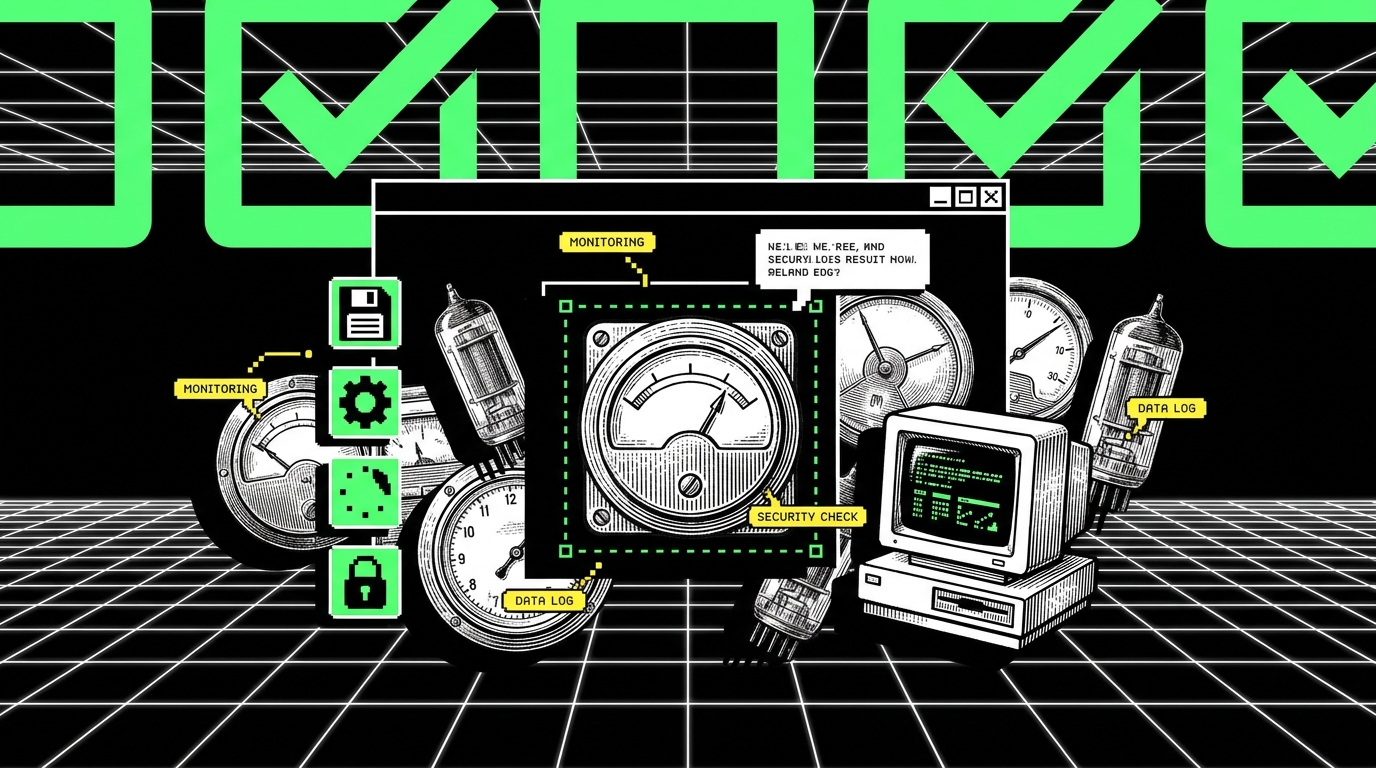
You do not need enterprise-grade everything to launch, but you do need basic operational competence. Otherwise, every new customer increases stress and slows development. The goal is to make failures visible and recoverable.
- Monitoring: track uptime, error rate, and saturation. For example, API 5xx rate, queue depth, and database CPU.
- Alerting: pages based on user impact, not on every log line. Example: “checkout failures > 2% in 5 minutes.”
- Incident process: a short template with timeline, root cause, and follow-ups. Measure MTTR (mean time to recover) in minutes or hours.
- Deployment safety: canary releases or feature flags for risky changes. Track Change Failure Rate as the percent of deploys that need rollback.
Data integrity evidence: what you must prove when data matters
If your product touches money, identity, or regulated data, data integrity is part of production readiness. This is where prototypes often cut corners, and where founders get surprised later. You need to prove that the system can explain itself.
Concrete practices that count as evidence:
- Audit logs: who did what and when (for example, “user X changed payout account at 14:03”).
- Idempotency: safe retries for operations like payments, so double-submits do not double-charge.
- Backups and restore tests: not just “we have backups,” but “we restored in a staging environment last week.”
This is also where security stops being a checklist and becomes a design constraint. Even in an early Launch, you should have clear rules for secrets (no API keys in code), access (least privilege), and data handling (encryption in transit, and at rest when appropriate).
When to hire with intent (after the product shape is proven)
Hiring with intent means you hire for the work you can now describe, not for the work you hope exists. Once the product shape is proven, you can define domains, interfaces, and operating constraints. That lets you hire people who fit the next bottleneck instead of hiring generalists to wander in ambiguity.
Product shape is “proven” when three things are true at the same time. First, a defined user segment repeats the core behavior (retention). Second, you can acquire users in a repeatable way (even if it is manual, like outbound). Third, the product has a clear value metric you can optimize (time saved, revenue generated, risk reduced). Without these, hiring more engineers often increases options, not progress.
A practical hiring trigger list
Instead of hiring because you feel behind, hire because specific constraints are now real. These triggers are observable and force you to name the problem.
- Backlog pressure with stable priorities: the top 10 items stay mostly the same for 2 - 3 weeks, which means you have focus.
- Operational load: support tickets per 100 active users are rising, and engineering is spending more than 20 - 30% of time on fixes.
- Release bottleneck: deployments are risky or slow, and Deployment Frequency is low (for example, once every two weeks) because the pipeline is fragile.
- Sales blocker: the same missing capability blocks multiple deals (for example, SSO, SOC2 evidence, or data export).
These triggers also map to roles. A release bottleneck suggests a platform or DevOps minded engineer. A sales blocker around security suggests someone who can build access control, auditing, and compliance evidence. A support load issue might suggest a senior backend engineer who can stabilize the system and reduce MTTR.
Team shape: small, senior, and measurable
After validation, a common mistake is to hire too many people at once. Coordination overhead grows fast: more meetings, more merge conflicts, more unclear ownership. A smaller senior team can often move faster because they make fewer wrong turns and write less accidental complexity.
Make the team’s work measurable with a balanced scorecard. Include delivery metrics like Cycle Time (median time from “in progress” to “deployed”), operational metrics like MTTR and Change Failure Rate, and product metrics like activation and retention. If you only measure output, you will drift into a feature factory: a team that ships many features while user value stays flat and support load rises.
Which path fits your next step
Validate before you hire does not mean never hire. It means matching the engagement to the evidence you already have.
- Bounded validation, then launch: the Agentic MVP menu runs Validate, Launch, and Scale as fixed packages.
- An AI-built demo to harden: Prototype to Production triages a SaaS-shaped prototype onto a production foundation.
- Senior engineers embedded month to month: Hybrid Teams covers the next bottleneck without a hiring cycle.
- Scope outside the fixed menu: classic PoC/MVP Development shapes delivery around your constraints.
- An engineering org adopting agents: Agentic SDLC turns scattered AI usage into a governed delivery system. That path is for teams, not a substitute for validation.
Conclusion: prototype to learn, then hire to execute
Bounded prototypes are not about avoiding engineering. They are about buying the right kind of progress early: evidence that reduces uncertainty. When you validate first, you can map capital to the right phase, avoid premature complexity, and make hiring decisions based on real constraints.
Validate should produce measurable user behavior and clear next questions. Launch should produce operational stability you can defend, like reliable deploys, monitoring, and fast recovery. Scale should produce reliability and efficiency, backed by SLOs, performance targets, and cost per active user. Once the product shape is proven, hiring with intent becomes straightforward because you can name the bottleneck and the outcomes you expect.
If you are unsure where you are, use a simple test: can you state your current goal as a number (activation, retention, paid pilots), and can you explain what evidence would change your mind? If you cannot, you are not ready to scale a team. You are ready to bound the prototype and learn.
Start with a product fit conversation. Bring the problem, the user, and the evidence you already have.